
Surprise Attack! Revolution carried through by small conscious minorities

Surprise Attack! Revolution carried through by small conscious minorities
Kabul in the Republican Revolution of 1973

Wednesday, April 15, 2026

Speech at St. Catharines Mayor's Town Hall for St. Patrick's Ward (Ward 4)

I am Saleh Waziruddin, president of the Park Towers Tenants Association. A few of the other tenants from our association are also here tonight.

Our building is one of the larger buildings in our ward and is owned by a REIT, a corporation that owns five buildings in this City. To squeeze more profits they’ve taken away our visitor parking, which makes it difficult for tenants who get visits from carers like nurses and PSWs.

It would be great if the City could give free parking passes to carers while they are working. That way they don’t need to worry about getting a ticket if their visit runs over.

For future buildings, the parking space requirements should include a minimum number of free visitor parking spaces to make it easier for tenants to get the care they need.

Some years ago the city had added hallway heat as a vital service landlords have to fix within 24 hours, but a few years ago when tenants in another building owned by the same REIT that owns ours tried to actually use this by-law, City Council voted to remove this protection. I am glad that three of you voted against doing that. What’s the point of by-laws to protect tenants if City Council is going to side with corporate landlords when we try to actually use these protections?

On Monday night one of the alternatives staff proposed to City Council for having staff time to enforce against vacant buildings downtown was to stop enforcing the vital services by-law entirely. This means heat inside the apartment, not just in the hallway. Many of the members of our association don’t have heat and use space heaters, they don’t want to complain. It’ll be even worse if the by-laws that are supposed to protect them aren’t even going to be enforced.

I’m glad the issue was deferred on Monday’s Council meeting but it will be coming back.


The next parts I am speaking to are from me personally and not on behalf of the Park Towers Tenants Association.

The other part of that option was not enforcing sign and graffiti by-laws. There are white supremacist groups active in Niagara who are postering and graffiti-ing in our wards and the City has an obligation to tear these down as by-law violations, let alone intimidation of residents. Please don’t remove enforcement of these by-laws.

Recently some of you said in the news that you don’t want to add costs to developers by having the City clean up the GM lands. But the costs will have to be paid one way or the other. It’s urgent to get those lands cleaned up, it’s better to clean them up now and then figure out how to get costs recovered from those who are responsible later. It’s better to delay development even 20 years if it means we can save our health and our lives right now.

The concerns about safety downtown are not new. Even the previous mayor and police chief they pointed out downtown is actually safe, even if the perception is it isn’t. More police and security guards may make some people feel safer but make many of the rest of us feel unsafe. Niagara Region Police has the second worse disproportional use of force against Black people in the province, worse than Toronto and Peel. Some of the high profile crimes downtown have happened right around the corner from officers, so more police won’t prevent crime.

Likewise you have a lot of pressure on you to remove unhoused people from our sight. But what we should be doing is providing supports even in encampments, because we don’t have the housing, like they are doing in Halifax and Kelowna. The anti-encampment by-law, misnamed the public space use by-law, because it’s about encampments, is not only a human rights violation allowed by the courts but is also a moral violation. It’s bad policy because it ends up making the problem worse through creating a revolving door for the unhoused. Anti-encampment enforcement might sell well, but is short-sighted and doesn’t work in the end, and you should know many of us oppose it.

Sunday, April 12, 2026

St. Catharines tenants’ 3-year fight over rent increases still unresolved (St. Catharines Standard)

https://www.stcatharinesstandard.ca/news/niagara-region/niagara-st-catharines-above-guideline-rent-hikes/article_1d3ead6c-0af8-5409-b6e4-307efb12f1cb.html

Tenants at an Ontario Street building have been fighting above-guideline hikes before the Landlord and Tenant Board.

3 min read
 (3)
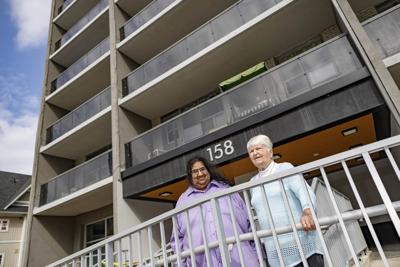
Tenants on balcony

Tenants Saleh Waziruddin, left, and Joan Coburn of 158 Ontario St. in St. Catharines have been fighting above-guideline rent increases from their landlord, a real estate investment trust, for more than three years.


After years of waiting, tenants of a St. Catharines apartment building who are challenging above-guideline rent increases may soon see their concerns addressed.

For almost three years, tenants of 158 Ontario St., a 75-unit, 10-storey building near Montebello Park downtown, have been contesting the increases.

They first appeared in a pre-hearing conference before a Landlord and Tenant Board (LTB) tribunal Oct. 6, 2025, as parties attempted to negotiate an amicable solution. 

InterRent, a $4-billion multi-residential real estate investment trust operating about 13,000 residential suites across Canada, purchased the St. Catharines property in 2020 and soon after started renovations to common areas and balconies.

The Standard reached out to Renee Wei, InterRent’s director of investor relations and sustainability, and company lawyer Martin Vervoort for comment, but received no response. 

Some tenants say proposed rent increases at the building could make them homeless.

Tenants face a combined increase of about eight per cent, with a 2.5 per cent provincial allowable rent increase from 2023, and a further 5.5 per cent for balcony restoration and the addition of LED lighting retrofits, said documents filed with the LTB. 

An online LTB hearing was held Jan. 26 for tenants and the landlord to submit written documentation. An adjudicator was expected to reach a decision on the case within 30-60 days, but no decision has been issued as of publication. 

Joan Coburn, 86, a former building superintendent who has lived in the building for more than 30 years, said she saw minimal rent increases under the previous landlord, but since InterRent started renovations in 2022 and filed for above-guideline increases (AGI) in 2023, on average her rent has risen about $70 per month.

“Every year, I get this humongous (rent) raise, so I end up calling,” she said.

“I said, ‘Look, I’ve got a computer. I can do my own math, and I know 2.5 per cent doesn’t come up to that.’”

Under LTB rules, tenants must start paying the AGI increase right away or hold the potential rent increase amount when the AGI is filed. Any outstanding balance between tenants and landlord must be settled upon final judgment or tenants could face eviction and landlords could face penalties. 

Coburn counts herself lucky she has supportive family. But even so, as a pensioner on a fixed income, she has had to take drastic measures to afford rent.

“I eat a lot of macaroni. I don’t buy meat anymore,” she said.

“I sure as hell don’t buy a case of beer,” she said half-jokingly.

“As long as I can afford to keep my car on the road,” she said, adding her six grandkids last year put new tires on her vehicle and this year paid for her underground parking spot.

Coburn said the baseboard heaters in her apartment have not worked properly since being installed last summer, and she had to buy a space heater after requests to have the matter fixed went unaddressed.

As superintendent, Coburn said she kept on top of building issues, including replacing the hot water tank, addressing electrical issues and replacing windows.

“These guys (InterRent) came in and threw some polish on it to make it look good,” she said. “They ripped out the old carpet and put in new carpet and painted the corridors dull black.”

LTB documents filed by InterRent, and provided to The Standard by tenants, said the REIT is seeking a 5.5 per cent AGI increase dating from renovations started September 2022, with papers filed once work was completed in 2023.

LTB usually limits AGIs to a maximum of three per cent annually,  to a maximum nine per cent over three years.

In the LTB papers, InterRent said balconies and LED light retrofitting cost more than $712,000.

The tenants’ response said had InterRent done its due diligence, it would have known the state of the balconies when buying the property.

“The balconies had been deteriorating for many years prior to the purchase, indicating deferred maintenance by the previous owner,” said the response.

“Costs incurred to remedy deferred maintenance are not eligible for AGIs under the Residential Tenancies Act and its regulations.”

According to the Tribunals Ontario website, “expenditures for routine maintenance or work that is substantially cosmetic in nature are not considered to be capital expenditures and cannot be claimed in the application.”

Geraldine Purdy, a pensioner on a fixed income, has lived at 158 Ontario for more than 20 years and also struggled this past winter with no heat due to faulty baseboard heaters.

Each time she complains, she said, nothing happens. Purdy believes it’s a way to make her and others paying below current market rent choose to leave.

“They want us out, that’s it,” she said. “That’s why they never fixed anything.”

Purdy fears as AGIs continue, she and others like her are going to be slowly priced out.

“I’m going to run out of money. I’m not going to get a job at this point,” she said.

“Coming in here, I said this is my last move. I’m not moving again. They’re going to have to carry me out of here.”

Purdy said she has family, but won’t impose on them should she be unable to afford rent.

“They have a life of their own. They don’t need me hanging around,” she said.

“My granddaughter has her house, but (has) her baby, and my grandson just bought a house, so, I can’t go with anybody and my brother’s here.”

In response to AGI concerns, the renters recently formed a tenant association to advocate for themselves.

Its president, Saleh Waziruddin, said tenants don’t have the luxury to breathe easy.

“In the (LTB) pre-hearing held in October, the landlord-tenant representative tried to get a negotiation (started) between the landlord and the tenant, and the landlord only went down one per cent,” he said.

Tenants voted unanimously to turn down the offer, Waziruddin said.

“We’ve got nothing to lose. (The landlord is) only going down one per cent, so let’s say no and fight this, because now it can’t get any worse (than what is offered),” he said.

“We don’t know what the result will be until the LTB makes its decision,” he said. “We know if the 5.5 per cent (from the AGI) … goes through, that will hurt a lot of people.”

Matthew P. Barker

Matthew P. Barker is a St. Catharines-based general assignment reporter for the Standard.