

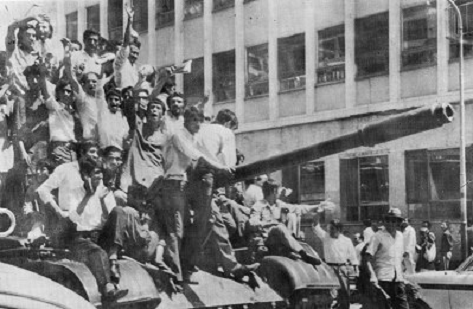
So what is "terrorism"? Most definitions, such as that of the UN, say it is an act of violence against non-military targets, and other definitions add that it intends to coerce others to meet certain political goals. This, of course, begs the question about what a military target is, and what forms of "coercion" are permissible and not permissible. It is also interesting to note that definitions such as that of the UN explicitly stipulate that terrorists are those who are acting independently of a specific country (although the UN definition does make the blanket claim that all war crimes are acts of terrorism).
So what happens when a professional military force of an established country invades a territory? It uses force to impose a political "solution" upon the civilian (not to mention military) population. It may not bomb busses or assassinate political leaders, but it does use coercion.
What happens, however, if a political entity is not established? If the people do not have an "established" country - if they have been forced (coerced) out of their land or their freedom of self-determination has been taken away by a professional military force? What if a group of people is too poor to buy brigades of tanks, batteries of artillery pieces, or squadrons of bombers? Is war something only for those who have big bank accounts?
Such thinking outlaws "popular" (i.e. grass roots, as opposed to bureaucratic) struggles, and "Peoples' Wars," where guerillas fight the "establishment" they believe to be depriving them of their rights. These people may not be able to win by spending a lot of resources on tanks, but they have advantages in other areas. They have time on their side - they are not the invaders. A good strategy for them may be to harass the enemy, to not let them rest, and to fight by stealth in small units rather than by massive military operations of well-equipped forces.
Is it right to hurt and intimade people just because they disagree with you? Of course not, and perhaps this is the meaning of terrorism that most people might agree with in a non-political sense. However, what about civilians who serve the military of an invading force? What about the bureaucrats who assist dictators and exploiters in imposing their will on others? What about colonists and settlers who are armed and believe they have an ideological duty to clear certain lands of "out-group" populations?
Freedom fighting is not only about fighting people who wear uniforms, and it is not only reserved for the rich and one of the "official part of a division of a nation," as the UN says. It is about fighting for the right to live the way one wants to live in one's areas, without taking away that right from others. The enemy may be in the military, or they may be civilians. The maintenance of oppression may stem from military bases, or they may stem from government buildings. Care should be taken in not automatically thinking that only coercion by and on military targets is justified, and that civilians could not possibly be oppressors. It is usually the civilians that send and pay for the professional soldiers to impose their will on others (i.e. in "unjustified" offensive operations), that form the colonies to populate regions after they have been depopulated of their inhabitants, and that believe it is acceptable to use coercion to implement political goals as long as they do it under a flag of the status quo.
Comrade S
(Please note I no longer support non-centric curriculum, this essay is from my pre-Marxist days)
There is a disparity between many ethnic groups in the United States in terms of literacy, education, employment, and other indices (Ogbu 143, Applebee 10, 11). Whites in America have a significantly better chance of having higher literacy levels than Blacks, Hispanics or Native Americans (Ogbu 143, Applebee 10, 11). What effect, if any, does curriculum have on this disparity?
American students are told about inventions made by Europeans, but how much coverage is given to advances made by peoples of other cultures? Barba reports in "Who Really Discovered Aspirin?" that most college graduates did not even know that something as commonly used as the compass was invented by a Chinese man (Barba, 27). In fact, most of the advances made by non-Europeans and women are often relegated to footnotes (Barba, 26). Several discoveries made by non-Europeans, but reported by Europeans, are credited to the European reporters (Barba, 27).
The Ancient Egyptians are treated as though they were not really Africans, although Diodorus of Sicily wrote that the Ancient Egyptians were probably the descendants of Ethiopian colonists (Wilson, 253). Ancient Egypt is often covered in a different chapter than the rest of Africa, or even as a part of the Middle East (Wilson, 254). Even when the Ancient Egyptians' contributions are mentioned, the influence of the ideas of the Ancient Egyptians on both Europeans and Africans is ignored (Wilson, 254). There is a tendency to ignore the ethnicity of non-European inventors.
The curriculum is in fact "Eurocentric". This means that when it discusses the history and development of various fields and world culture in general, it dwells only on European contributions and influences. The curriculum in fact implicitly promotes racist ideas * namely, the idea that only Whites have the intellectual ability and intelligence to succeed in the sciences, as well as in the arts and humanities.
This racism does not restrict its manifestations to contributions to world knowledge and culture. The presentation of non-European cultures is often only in the context of those cultures' relationships to Europe. For example, the African kingdoms of previous centuries are often mentioned only in the context of the slave-trade (Wilson, 254). "Everyone is now taught about the great civilizations of Rome and Greece, but how many people learn about the mighty empires of Ethiopia and Ghana?" (Vann and Kunjufu, 490).
African resistance to colonialism is often ignored, especially when it was successful. For example, Menelik II's successful defense of Ethiopia against the Italians at Adwa, or the Algerian war of independence, are often ignored (Wilson, 254-55). Often the presentation of the history of African Americans starts with slavery (Vann and Kunjufu, 490).
Discussions about Africa in most American high school textbooks often concentrate only on the problems of the continent. The photographs are limited to "camels...soldiers, and [Nelson] Mandela," and not African cities or industries (Wilson, 256). Also ignored are colonial causes of some of these problems (Wilson, 256), such as the civil strife caused by displacements of populations and the institutionalization of inequitable power structures. For example, rarely is it mentioned that a number of the ethnic conflicts in African countries stem from the fact that the borders of these countries often reflect colonial zones of control and not the territories of different ethnic groups.
This bias in coverage has several effects which contribute to the disparity problems in literacy and employment levels for the different ethnic groups in America. Andersen in "Worldmath Curriculum: Fighting Eurocentricism in Mathematics" discusses one of these effects:
"Every aspect of the educational process and every facet of industrial and technological activity must convince the majority of people especially people of color that they are biologically, intellectually, and /or psychologically incapable of understanding mathematics" (351-352).
The Eurocentricism in the curriculum disinterests minorities in subjects such as mathematics and science, as they feel that only Europeans have the "gifts" to succeed in these fields.
Another consequence of the Eurocentric bias in American high school curricula is that White students, especially males, are given false impressions of their superiority over other races (Barba, 26) The neglect of non-European contributions to world knowledge leads to a low level of self-esteem among minorities (Vann and Kunjufu, 490). The consequences would only be theoretical if it were not for minority authors who have elaborated on their personal experiences with these consequences. Annette Henry in "The Empty Shelf and Other Curricular Challenges of Teaching Children of African Descent: Implications for Teacher Practice" says:
"...these lessons that perpetuated notions of Black people as inferior and primitive, I can still painfully recall shrinking at my desk, wanting to disappear.... School was not a place where I could ask any practical or critical questions about the ambiguities in my own life as a Black child in a White Society" (Henry, 299).
It may be important to understand how the curriculum came to be so Eurocentric in the first place. If Eurocentric curricula downplay the contributions of non-European peoples and if they promote racist attitudes, how did they come to exist? Several theories have been put forward to explain how this system came to dominate American high school curricula. Rod Janzen in "Five Paradigms of Ethnic Relations" says non-Europeans where never fully accepted as "Americans" by Whites (349-350). They feared that America would become less European, become "physically darker, less Christian religiously, and less European with regard to its understanding of the best way to design social-institutions" (349). Whites, wanting the non-European Americans to become more like them, may have designed the curriculum to be Eurocentric in order to assimilate the non-Europeans into what the Whites saw as the "true" America a European, Christian America (349).
Other authors suggest an even stronger form of racism as the cause of the Eurocentric bias. Marilee Rist in "Ethnocentric Education" suggests that the Eurocentric curriculum was established to prevent minorities from challenging the power of Whites in America (29). John Ogbu in "Literacy and Schooling in Subordinate Cultures: the Case of Black Americans" claims that racism in the education system stems from a caste-like dimension of the American social structure (140). According to Ogbu, the discernible difference in literacy rates between Whites and Blacks in America is caused by various forms of racism in the American social system (140-145). This results in the establishment of "ceilings" to chances for attaining high literacy rates for minorities ceilings because minorities cannot progress in society because they are held back by systematic racism (140-145).
An increasingly popular solution to the problem of the Eurocentric bias in American high school curricula is to shift the curricular viewpoint from a Eurocentric one to an Afrocentric one. Similarly, Hispanic-centric, Native American-centric, and other similarly-centric programs have also been proposed (Janzen, 349-352). In this paper the term "non-European centric" will be used for the proposals which use a non-European culture as the culture whose contributions and influences are emphasized. A clarification of nomenclature must also be made. Afrocentric, and other non-European centric curricula, are often substituted for multicultural, and vice-versa. In this essay, these two groups of words will be treated as almost antithetical ideas. Afrocentric and other non-European centric refer to an African or African-American (or, alternatively, Hispanic, Native American, etc.) world view, whereas multicultural will refer to a world view which (at least in its intent) is not centered around any ethnic group.
Non-European centric proposals ultimately propose that members of different ethnic groups be separated, at least for some hours during the school day, so that they can receive education centered around their ethnic group (Gill, 574). Emphasis will be placed on contributions to society by members of their own ethnic groups. It is hoped by the proponents of non-European centric curricula that this specific emphasis will raise the self-esteem of the students, and that they will develop an interest in different fields (particularly in mathematics and science) which will help bridge the gap between minority groups in these areas (Gill, 571-576 ; Janzen, 350-351). This calls for a certain level of autonomy for each ethnic group in terms of high school curriculum, as it is assumed students can derive the most benefit from receiving education centered around the community they identify with most.
There are a few problems with this theory, however. One is that there may be a decrease in the efficiency of societal communication due to the lack of uniformity of education and the fostering of divisiveness (Janzen, 351). Similar curricula can help students from different ethnic groups understand each other better, and the increased socialization may similarly foster greater racial harmony. Another problem is that these non-Eurocentric approaches will not eliminate the potential racism which could arise from teaching a world view centered around any group. If minorities feel that their culture is indeed superior to the European culture, they may develop prejudiced attitudes against Whites. Racial divisiveness is obviously not beneficial to any society.
The problem with Eurocentric curricula is not that they are centered around Europe, but that they are centered around any particular group. This problem persists in Afrocentric and other non-European centric proposals, as they are still centered around an ethnic group. This centricism is what causes the racial divisiveness which has been a key factor of the problem of the disparity in literacy rates.
If the contributions of ethnic groups should not be overemphasized, should they be underemphasized? If the contributions of all ethnic groups to world knowledge and culture are recognized, students of all cultures and communities can build self-esteem and become interested in fields which Whites presently dominate in America. This cannot be done if the ethnic identities are ignored altogether, as recognizing the ethnicity of contributors to world knowledge is an opportunity to build the self-esteem of students from the ethnic groups. Not centering curriculum, while meaning not overplaying any culture, does not mean underplaying any culture either.
So what is needed is a curriculum which attempts to be free from presenting a world-view centered about any culture. Of course, although this is possible in theory, there are bound to be some prejudices entering textbooks and curricula, due to the fallibility of the humans who design curricula and teach students. Is it possible, however, to compensate (to some extent) for these subconscious tendencies?
An effort must be made to teach teachers about how to be conscious of biased views in educational materials. Teachers must be better informed of the Eurocentric biases in American high school curricula, and they must appreciate the direct relationships between this bias and the disparity between different ethnic groups in literacy rates and economic achievements in America. They must then try to ensure that the material does not overemphasize the contributions of any culture, and does not ignore the contributions any culture either. It is hoped that these measures can change the ethnocentricity of American curricula in a practical way, and the impacts of these views on the disparity in literacy rates between ethnic groups in America can then be decreased.
Andersen, S.E. "Worldmath Curriculum: Fighting Eurocentricism in Mathematics". In the Journal of Negro Education, v59, n3, pp. 348-69, Summer 1990.
Applebee, Arthur N., et al. "Learning to be Literate in America". In Report No. 15-RW- 01, The National Assessment of Educational Progress: The Nation's Report Card.
Barba, Robertta H.; Pang, Valerie Ooka; Tran Myluong T. "Who Really discovered Aspirin?". In the Science Teacher, v59, n5, pp. 26-27, May 1992.
Birrell, James R. "`Learning How the Game is Played': An Ethnically Encapsulated Beginning Teacher's Struggle to Prepare Black Youth for a White World". In Teaching and Teacher Education, v11, n2, pp. 137-47, March 1995.
Gill, Walter. "Jewish Day Schools and Afrocentric Programs as Models for Educating African American Youth". In the Journal of Negro Education, v60, n4, pp. 566- 80, Fall 1991.
Henry, Annette. "The Empty Shelf and Other Curricular Challenges of Teaching Children of African Descent: Implications for Teacher Practice". In Urban Education, v29, n3, pp. 298-319, October 1994.
Janzen, Rod. "Five Paradigms of Ethnic Relations". In Social Education, v58, n6, pp. 349-53, October 1994.
Ogbu, J. "Literacy and Schooling in Subordinate Cultures". In E. W. Kintgen, B. Kroll, & M. Rose, eds., Perspectives on Literacy. Carbondale: Southern Illinois University Press. pp. 129-153. 1988.
Rist, Marilee C. "Ethnocentric Education". In the American School Board Journal, v178, n1, pp26-29, 39. January 1991.
Vann, Kimberly R., and Kunjufu, Jawanza. "The Importance of an Afrocentric, Multicultural Curriculum". In the Phi Delta Kappan, v74, n6, pp. 490-91, February 1993.
Wilson, Angene H. "Teaching about Africa: A Review of Middle/Secondary Textbooks and Supplemental Materials". In Social Studies, v86, n6, pp. 253-59. Nov-Dec 1995.
-----BEGIN PGP PUBLIC KEY BLOCK-----
Version: Keybase OpenPGP v1.0.0
Comment: https://keybase.io/crypto
xsFNBGN/FH0BEADCpDxjRLpyqiOq9usBMz+5Ze3vQlI8cUX2ktPiQ+3IH+U/H5f9
3oRh/9whJLWvfn8awus0yknvwjWEDI/3G3WmF89A6YBPZWIHbPzGEva9vGpu4K5Z
/iz0zDrm/u5x3CHdjzn65zV9fTEsGk4yn0l27I7pnVWd2xi7Owd5EBpYaJ02Kt9n
Dt+ZNdI91kXTJW+UltY5G6LRS3AGAWUf5kU4DbkQ45FlAhDB+34/w3zYYnz0TPNM
FAmlwhiubThrGmu7v/HDQBN5tOp1sa5YUpg0EQGwlLs8DGzfLxYS3vTF187pYS/8
YFJJDEK8f2oHDqP4oh9A+JNjIlrvwgKjLJh4W1PqLs/jAZqwCjOvg+Tk8LEe6pVc
7uPvEx0RzDYPff+NW32QJzGAENdy1gbuckY+h5oiDKM138hL5ZMZ8zCdjP50Z5vF
m+U1WMVW6830wZ+EK3LVI5g0QiJCxMnXMykl39Jm2VgjlP+1zfHufQpRIUbdr1WC
OQAxbdzH3g+HLP2i0oOBr9qW3U0VcENAqYGuzy+LlN7ogepUEsVS/HKwtMu22CpP
rnlxlmuhuf8AVyD/YJbUC8ZE8ciXTBehck3zNcPXT22PKeh7zpMnVbkZu1cQzhkm
kKptYYVulzlf4uflBstotfvDp5z64V9NGGzRTFYxaQCbgTse7O7rR7cpkwARAQAB
zSNTYWxlaCBXYXppcnVkZGluIDxzYWxlaHdAeWFob28uY29tPsLBbQQTAQoAFwUC
Y38UfQIbLwMLCQcDFQoIAh4BAheAAAoJEHoIKxvUySVqDnIP/21zIs4oZpmkCn2V
CAdaW5Xxv6ik5bbhKQje2kL7RtKtY1X7ZVjq2hrPw5NxVkZAIzCzIVQGKz86qXQX
BX9uCWkOfD/WGv0qwSqlJBji/jJvz7zE/mu9ew7DxB7NmbZ5WZb6Sxa9JbofBoJg
BuT3zngH5xcpyoZUiriuBZsqKX+QHMSN/FTJyqngFzG7YvLUyHHbo0iysUlddtt0
sKI9LOwcBNp1XbkzKeo7KaQOwcA8u+xCNLkb49l7+YBNeB4HIm7A3YO6xuvu2Ar+
foN5ApaF6MfRUc6gZB9+pG1YLC5SqgGRoQfKlqWJB2P4Q+yf4gAKafHMbLitlisU
BBn/ALddl54EdVt8dRsodUsc4ZOqOhqNJvo1wvZGjp8StPc1AXM/vpqH6IVLgths
Jui1z1l2+N2Zh77g9BkjO3Ek6Xm9JF2bgLEw7IGO4jblg6IUqginxDS1MVx1H9d9
OeuJ3aqejgkYB2ZMrIxBVLUsIEssHk0LWrRUwJ4eQTcwETLf+VgBjFv5jaVA7kuh
VYo69CWCg2Fxqr8xX32aMRaa1gHPV/9YaRQ8bBPVT40KdfDWut6U3AaQYC4ev2j/
SD98wIIxGsluh891QMl9rB4hqLw8ArJiAsNGLAM2o2dgLg8nOysjltC1aqOzYU3o
U7ZKiV0gXlq+z9a8S1eychCwdQqzzsFNBGN/FH0BEADOzEVamO53MZpFjemMBih5
fDaBR+IR3z2sQxe1QeVfYzHZHbFAc1djhDHmcVok7mewVIDEijzgZ1a2hk7mzQLy
7LGorjYLPbIYN5knS/cCQqeR/7xXK6jtToaU41wUk1FhKsfvPRGlPXJY4glz3Utx
gwKvC0qJ1SIJzEyLIkrmXwDUmISnAKOwfyZD6tDx1D1j2gnNaqd6duozajy1ScB2
0HqquuJCxH7NQ1nKmW+rghzJ4Ra9+GK4qa32q5QUtXI7EuYo5ichMlTJVeSpKLTH
puPAtwZ2Lkx7/LKDcVSG/Q0quLu8YRdSgkuwPM9dI7dVtDCqLrieQHrbT7F4a4YC
pidsgEBeIWGkC7Xg4bKsPtyp167uSc2MWLMdxHNaGJnwMHE3LybVUY6cDc4I5Gx1
Exf5qZqUOIghHvxcemkCoSIXlr/Y/zANo+ND8MORIYNYHr0p5CtMVKQiMw9wLku6
OqwyjeMnFP7rRHbnivY4GBxPE1Ypcu5bDJ9EgcnlIHDsuR3VH2FerxQ3HJJUmq1a
uGHLSZ417hX7yvF3jFyoKkacHj+f6oB4PUyaWI3xGZ1rCme8DB/NVM/WCrgkHIDs
jcxlBnP5pdqqW65txa0O6fORIsBknEEN0baeCjAdmvbGQWKUiNcyB1FKPkA8xC3S
deWxONG9ITdndF71nqTVuQARAQABwsOEBBgBCgAPBQJjfxR9BQkPCZwAAhsuAikJ
EHoIKxvUySVqwV0gBBkBCgAGBQJjfxR9AAoJEIWXlo7Z5JjPkLQP/AnVJYgpCNO6
WJmFxxX+8hIKKu1GJSkq7TFvp180/oPXv8JaK2OpVndbin1Bwd2Z7Ud2viLUsbPz
lL4slp4pUNwXeo3Xh83tFDEjDJzm53goxguJ4JVhYxxg5CIjtyd5Ks0HkGZjMcpX
tuTcB5QkzdhyaR8KseKl4aq+Ro3a8Kob5MoQkUDSwcVW0BbKnZ5C0c3tCmPwamNk
JJ9DP7lkG9uHfZc808ffVVfI5FhxxpKWmP0g0Y2Od+qx+Ka+GhRL61APv2FNPF7s
iT4RNNyizryryP9d70jj2L68bGzQlj/qEZqgqf7PwKO4C+NcoT7YvPed/7TyYLu5
9EJHXbKujD4PxrtzlPKq+16uz0OnoVT5hWS4/96GQHRepepFu88kd2j2ynD0k2bX
CjeHCE7tis15cCeLO1/rLbWbyUGlLdA4D7WkaL5ENJ9KPmr3GLnctG+BT6jrjRLN
xED4WdChCybofIgV07Pxjk3BiTBI2VeH+8+rtph7wBOoK7nVR5adAkJdgZr02dLf
nMB3cNrqaP9eV3LxHNi+1505b0McSFZ0sxMRXPOd7CYwalJN4jDSxboF4CtxJZRP
lbahGzRsCCE1Ek2FAJDVSLtmqua9FHY2p9z8317GnoKSvPNom9NGi4tSGxNDDf1p
5AdLtLrfTALL6EHJ9imvRUQOSUwv9d6lZi0QAMIFcmwZHBmByXUFInQLjnOu+3x4
t66ol8zNdtJqnr04EUuuGXFKSBwWA1EBNLovUOP4DthewalV4ugszYKchbZczQ4q
NZgTJktjDe92IB+dIoiFe5v6BeJvz8EBDJ6Pt15CQQFTBSnEeUY+sYWJxYMHh3T7
dzFEQg1hx7SjnU08hwaZZQTBUB7G5MCupcD9e7G8S7aG2IKMvD7xDfxUicOAvThw
FsK0IFvx8b/fuICWznle/Y5SYQn696k/KywZWgRdBJmF0rxCROmg1fMLQ/wiHDQv
GeJjs1YsyFsa8mWwwcjjQZ1g7mfJG2PrnsiCIK43Xqk4CTH/65S+DsxnU1zJEscl
8JaJ5Z5RHA+nf9TuuehmifI3q9xlJoBqJQFHMRsnZSe4XlcLTxpCJTrad+1FTquW
hW9fdvpyQNPy1krWsLcUDSVYQPBLWrPKOJQ2e3v76Z08t+hW9I4ITuTJilL6ElM1
7nPwoVqIVXOWKF//qybmuSfitdkm2EuWqLPXVmKhqxa6t8oNVQv0EDrZC8rQ3U9U
rWhZYd4LQ6NibZQhkTBVDOQDWitp4OvebA6iU9xfs8oEF1dUjtDX9qranymJQDSx
/0vYvRKoT5hKvF5PnypB1LcggbDtx8mKbmYp6UDrHjIfQPmrb30aMP96Nzomj7Oq
PHiIDIGZgYquHisUzsFNBGN/FH0BEADGV3wl5e3oz7dle4dLbQBzVfwaQ8shmAtu
4yAcv4IPJNbtQNFsegsPuoErhwf6F1EVgkVktg5Wa/ydKUGxvbu/m2A3AoxMfcSF
dxwRtQHP5M1+/CMFh/aNEiODQ9sSATv0HGtuk5Kbnp080YrhSRm2QfT9ZdVGFyP3
RkAorWZgBNV+qDw7KPyyJKfUx2WX5107RuMZr19PokA11n3+t4rmYNvmLOMFehWR
d5hNVoVcnrUYATC3SA77lmED6QNpuVfzcGA9VwfF4jwo0lHJcJG0Jegjix3OfgNS
OOaJoLdT21o27i9WIXfczRyJnbelD+fVYCXJy8JuW5dwMZd+0nZLILetdSR/D7YL
GuuwO2tK4JNHoy+t0ExUy6l8TEpOyjS9x3n0aud1oywhxSq/xhj1K+RLQe1XIkc3
X716OPPKTKQZC57hTC+pAj8pYw0dFmtSdP0Pr9NAB3Yobu2zAyRrDSocaHDC4ESh
tbaPf0VQ/rrqlztbjRVOs3s+qs50ppygpMv616KMamKy9czhey3E2yFLOlxamMf2
KVm4opzyI2VE3d2FivIgzvmWfDNeiRglJPc+4jfRZllHs6wALCg+Uj/l4e/WKQ4T
5y7B5nXNPA4ErJW/B4cIhSG+6kDmiUBXXNdXzsQjk4tAZ3HeYxy8drhRp3D6h+13
A0+PDkAmWQARAQABwsOEBBgBCgAPBQJjfxR9BQkPCZwAAhsuAikJEHoIKxvUySVq
wV0gBBkBCgAGBQJjfxR9AAoJEIc9befty2uVmK8P/3w2KsVoGRYMWQ9TWe17yUsq
XSyjqr2PTQVMQ+AT3liQ57Io4HQrcWZic1eJrfWeyCBgKrR8f0UxqeRp6SQYaUxd
dClsdrEcuXTQgyC3b+flvD18CuJNGSrFfNmuBl02URQmGgTuFetfmFBP+vQjCLFz
5E8FzCY1moUgoIq6Kjs5ZC6igbyAZjKVzlNTLd+AUGzDviexw+W10jFQO5K8sfyh
vAi1Z0zpZB5iECnm8eVHmz9WaECzzWGLRAfhnCiHw6DkFXCdiq6SlzTEveL2M+eF
VQoFrvOIyQiLc4kXX10rHGrk79155u8rpQEqitZA4q4n9RmR6hh2B4MGEgXXJy+y
m0Nf/wKgPMTd9VExE2GjTVYPoZ/TIEXyIa+5aEEmpknFMZkDCMqk7AYOHA46LTQY
Uyf3IeJUuyfLCVN1NpkmJL4r1EDKfuxHA8gOgZi/mHhYU8Yj8qVV8BB/3tJNMSC/
DsJBEVq4epKdWgKIbsXCroQA0mAQ+WrYNqFBkw7AP8JkKgmXfsRzaYlxpu6WUpUV
3adzhGZq7JwxypVP9QjmR1F7hn8E8jxtRDS0Wnn+acxSp/FWJOePwwOt+sBhNMnh
ld2rDK0XNcqbw4jXs0GAYzR+ssUqXyMd65+Djt4rHLoh4WnepmJ+WRFGYsrYyEnZ
CKhkGg0QYbdQdw2aLzxjSkAP/j+1a+1l1lr5aiKhr2VXbbQxoAqIdrygUt7o0U09
QDof9HXvsVTjd1JzCc5oL2N7LBtqWAOUdBstSi73a6s5y8L1KAmqDqO2iOsqcAYx
+X4LuNEU62YLPJb9Hv9YdBiscMRYOdsLVmQx2MuymeB3Je/wOgb3S2IqaigXeK2h
iFWecVSplGBMDmu4kUsd6as9OShJJSxVYfyyvoEE+v9ULeHlJBDHW7qp5sf2yEzK
6pPFBbRUUgIOouEG0fILZkfav/znY/3oyE/GZ/Dqe3sNXR9e2ZPKw8Xowtwmh/hP
bqJFj8OJK40Yd5HR/VZfZM5Eznp0OEi7Jz1J/lS0g95lP9j0zvahA/8RqAGwFkAf
C5zu+MLJYngq3M1E7Jtgc1Se8Q8gH/ZGCy1lb4RFzz8bnhjdwGmCAS5/VloDa4UK
JeznZcJ9AnA8qGNBrWuk6fSwpkTZ2mFA9d+eRG6t5+h0JU51kypA6VQnV5iokILl
xzCNAlhxcnc1IUfGTf2q+8jbjqemeDFtynjJmUE4e5dBY9xW+Kx1ykdNMZKjVbrH
FiukttPU2OKyaDFUFGBIegj5PgaDmC80RnDtPpJJKci2c9zOSBSw0B2vSeVfUec4
2CUSalSTRsC7nz2cdL09uR1bcI/6E/O0zKYu6FXLh69cpQJakJz8oKlYKKGX1/qQ
53tT
=EZ6J
-----END PGP PUBLIC KEY BLOCK-----


