(https://www.youtube.com/watch?v=uRUp4YbVIr8)
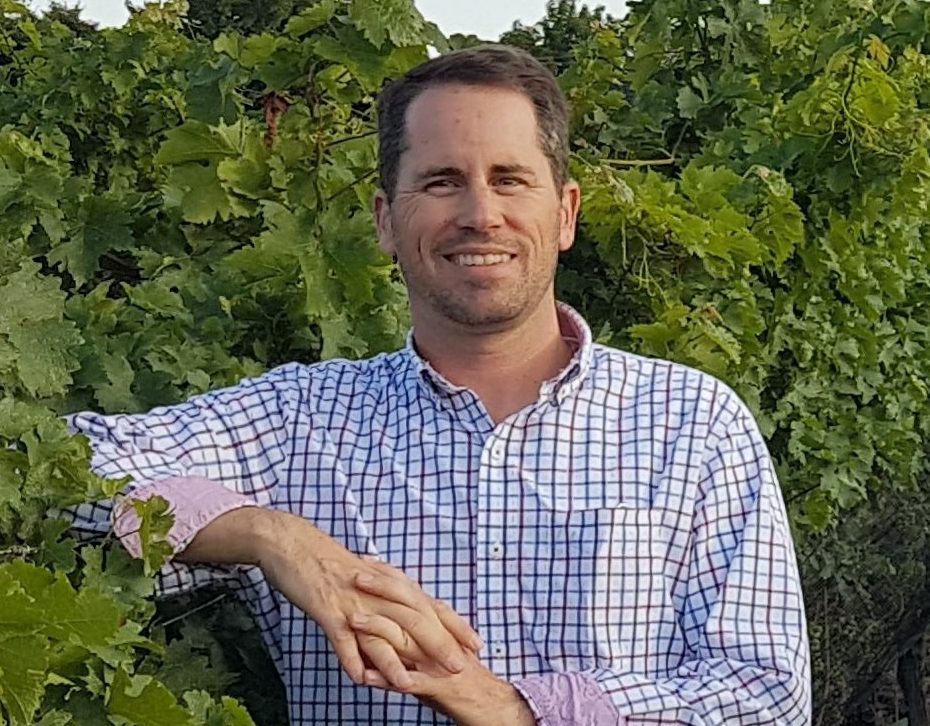
Interview on behalf of Niagara Region Anti-Racism Association
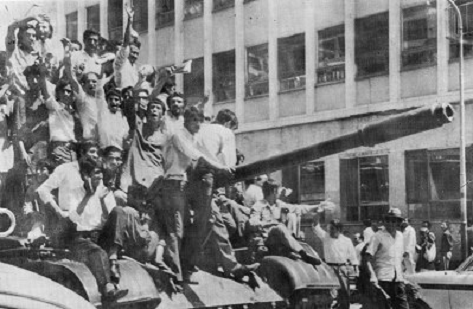
(https://www.niagarathisweek.com/news-story/10160547-the-long-road-to-reform/ alternate version https://www.stcatharinesstandard.ca/news/niagara-region/2020/09/03/anti-racism-advocates-remain-hopeful-for-change-in-niagara.html)


The tone was one of exasperation.
As members of the grassroots group Matter of Black met last week the topic quickly went to Jacob Blake, a Black man who was shot in the back by police in Kenosha, Wisc. To them, it was just another example of systemic racism.
It was also a reminder of how much work anti-racist advocates have in front of them. Not only in the U.S., but here in Niagara, where local efforts have been met with varying degrees of success.
“We’re seeing the very basic first steps. Change doesn’t happen overnight,” said Erica Williams, a Matter of Black member.
The group was formed to reinvigorate the regional Emancipation Day event, and works alongside BlackOwned905, which shines a light on businesses owned by Black people in Niagara.
Garden City politicians recently dealt with a motion that came through the city’s anti-racism committee that recommended 10 changes for Niagara Regional Police.
It passed after three recommendations were removed: body cams for police officers, police demilitarization and ending street checks. It was then included as correspondence to Niagara Region and the police services board in a separate motion brought to regional council by St. Catharines Mayor Walter Sendzik. That motion called for a series of reports from the NRP and was passed, though anti-racism advocate Saleh Waziruddin said much of the information was already published.
Waziruddin, a member of the St. Catharines anti-racism committee as well as the Niagara Region Anti-Racism Association, said he was frustrated with what he felt was politicians ignoring the comments of the Black, Indigenous and people of colour (BIPOC).
“Definitely there was a lot of resistance and just a lot of lack of listening,” he said.
An Indigenous man from Welland talked about being brutalized and racially insulted by police, but Waziruddin said he felt the man’s presentation was largely ignored by regional politicians who instead focused on the low number of complaints lodged against NRP officers. But with many people in the communities affected already distrustful of police, he said they’re not likely to come forward with complaints.
The Niagara anti-racism group is now setting its sights on the police services board, where Waziruddin said real change can happen. Members are planning a letter-writing campaign to convince board members to make changes.
“There’s a lot of activity going on still,” Waziruddin said. “There’s still a big opportunity for reform here in Niagara.”
Tamari Kitossa, associate professor of sociology at Brock University, cautioned that social movements take time, energy and money. In order for them to be successful, he said activists much continually recruit members who can bring fresh ideas and energy.
He also said advocates must learn from the past.
“They must, in fact, read history,” Kitossa said, adding that learning what worked and what didn’t work previously, can go a long way for current-day activists.
He also said supposed successes don’t always turn out that way. Kitossa used the work of Dudley Laws and the Black Action Defence Committee. The group formed in response to police shootings of Black men in Toronto and its work led to the creation of the Ontario Special Investigations Unit, which was supposed to provide more accountability.
Kitossa said the SIU has basically become “police investigating police.”
Though he’s cautious about this current movement’s ability to force real and lasting change, Kitossa said the local level is key, where activists can more easily access politicians and plead their case.
Siscoe doesn’t think the current movement is going to run out of steam before change is achieved.
“This is a bus that started rolling downhill and it’s not going to stop,” he said.
Waziruddin said the Niagara anti-racism group has formed partnerships with other groups including NEXTNiagara, the performing arts centre and Niagara Folk Arts Multicultural Centre.
Williams said members must not focus solely on policing reforms, and that racism exists in all institutions.
Siscoe agreed. He said he’s committed himself in recent years to reading about the experiences of BIPOC, both in Canada and the U.S., and drew parallels between the experience of Black Americans and Indigenous people in Canada.
“We need to start making sure all public institutions reflect the community they serve,” he said.
The movement, he argued, requires buy-in from everyone.
“It’s not good enough to be not a racist, we have to be an anti-racist.”
Williams said the work starts in people’s inner circles.
“It’s that co-worker you know is being harassed but you say nothing,” she said.
Story Behind the Story – Months after the death of George Floyd spurred anti-racism protests around the world, reporter Luke Edwards checked in with local activists to see how their efforts are going, and how they keep the momentum up.
Clarification – Sept. 3, 2020: This story was updated to clarify the separate motions brought to St. Catharines and regional council.
Interview on behalf of the Niagara Region Anti-Racism Association with Matt Holmes of CKTB 610AM on a recent police killing and white supremacist terrorism against demonstrators https://traffic.omny.fm/d/clips/4809bc8a-e41a-405c-93da-a8cf011df2f4/a9d6d364-a8cb-44f1-b837-aa14010af355/7cd214ee-30b0-49d2-b842-ac2600d96ca8/audio.mp3
(https://niagaraindependent.ca/st-catharines-council-calls-for-de-funding-of-local-police/)
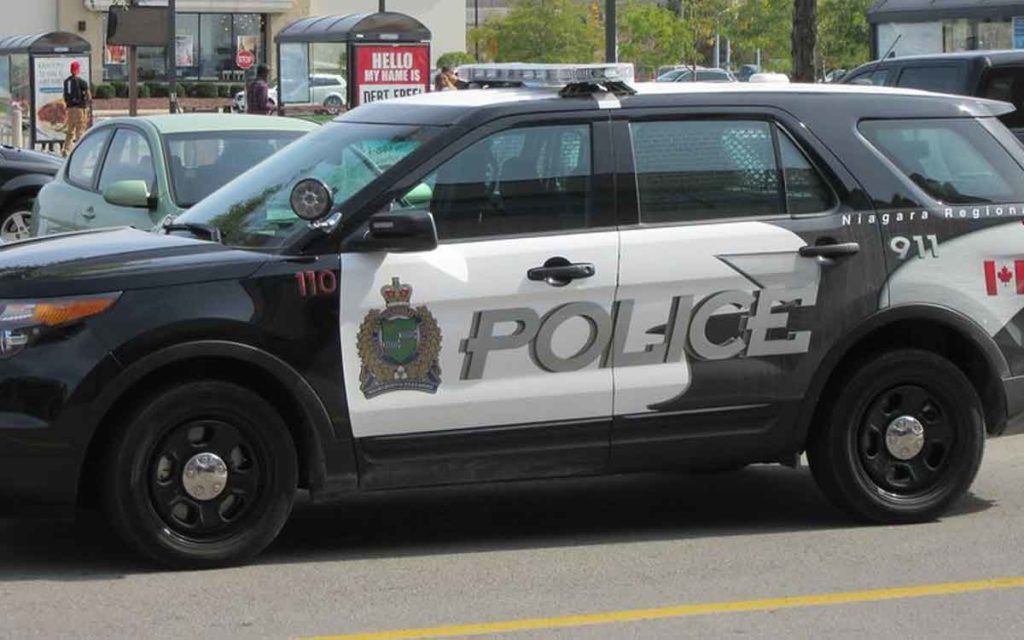
Earlier this week St. Catharines City Council opted to call on the Niagara Region and the Police Services Board – the civilian body that oversees the Niagara Regional Police – to “re-assess ‘adequate policing” requirements.
This motion was on the heels of a motion the city passed earlier this month calling for the decriminalization of personal possession of illicit drugs.
The call specifically asks for the NRPS and Board to “re-assess ‘adequate policing’ requirements based on removing welfare checks, mental health, and suicide threat calls, as well as foot patrols that are only demanded because of perception.” It also asks the Niagara Region to re-allocate the savings to a civilian service such as the EMS, Niagara’s ambulatory service.
The composition of the seven person Police Services Board is determined by the Niagara Region, which appoints four of the positions with the remaining three appointed by the Government of Ontario. The Niagara Region is the primary source of funds for Niagara’s police service.
Council’s decision represents an about face for the City of St. Catharines and particularly, Mayor Walter Sendzik and its preferred level of policing in St. Catharines. In October 2018, the previous Council including Sendzik – who was an outspoken proponent – had called for an increased police presence in the downtown area, including foot patrols.
Other initiatives that Council also opted to support included the establishment of a “purely civilian” oversight body that bars former police officers from participating; the release of race and hate-crime related data; requiring officers to intervene in instances of excessive use of force; require the consideration of an officer’s use of force during their performance reviews; the publishing of race and hate-crime related data, and increased training for officers in the areas of diversity, mental health and anti-racism.
Council narrowly gave the thumbs down to several additional proposals before them. Ending street checks, commonly known as ‘carding’ and the recommendation for the police service to sell its armored rescue vehicle and ban the use of tear gas or other agents against protesters were both lost on a tie. Local politicians and activists continue to refer to the rescue vehicle as an “armoured tank” a point the Chief was quick to correct. “It’s not a weaponized piece of equipment,” explained the Chief. “It is a mobile piece of safety equipment that I feel I am obligated to provide to our members.” He explained that the rescue vehicle is used in very high-risk scenarios to not only protect officers but members of the public who are in grave danger.
The vote on recommending the use of body cameras by police officers was also defeated by one vote.
“Racism is not, and will not be tolerated within the Niagara Regional Police Service,” Niagara Regional Police Chief Bryan MacCulloch told Council at the beginning of the debate. “I can assure you that that is in keeping of the values and the integrity of our members both sworn and civilian.”
When asked by Councillor Kevin Townsend whether the police force was “bombarded with complaints from civilians,” MacCulloch answered in the negative. He noted the service receives about 100 public complaints per year with a “large number” of the complaints being deemed vexatious by the Office of the Independent Review Director, the provincial body that oversees and manages all police complaints in Ontario.
Councillor Greg Miller’s comments included reference to a growing police budget over the past several decades. MacCulloch responded by noting the force has increased by 176 members since 2000 to deal with the increased demand, complexity, population and expectations that are being placed on police services through legislation. He also noted the financial impacts of the collective bargaining and arbitration processes.
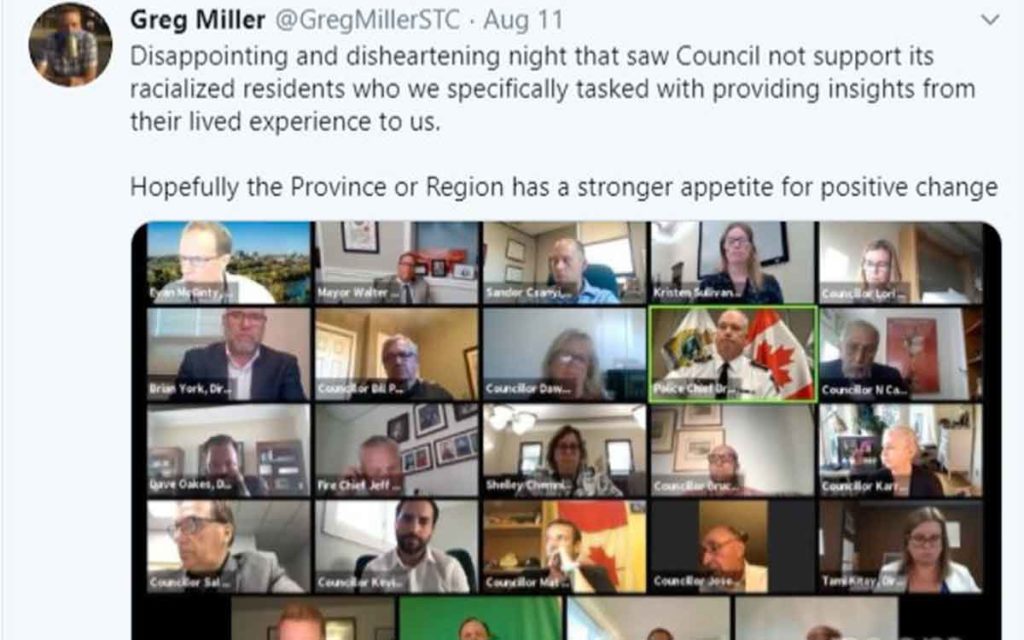
Miller took to Twitter following the meeting to voice his displeasure with some of his council colleagues, saying in part, “Hopefully the Province or Region has a stronger appetite for positive change.”
The recommendations originated at the City’s anti-racism advisory committee. The committee consists of 10 individuals and is led by Chair Saleh Waziruddin.
Waziruddin has previously run as a candidate for the Communist Party of Canada.
Speech as Delegation From Niagara Region Anti-Racism Association to Niagara Regional Council at Continuation Meeting on Police Reforms
I am Saleh Waziruddin from the Niagara Region Anti-Racism Association.
This is a very important conversation you are having, but it is missing an important part.
The BIPOC communities and other marginalized peoples who feel discriminated against and mistreated by police, and you heard from some of them last meeting and today, need to hear your support.
In the last few months cities from St. Johns, New Brunswick to Victoria, British Columbia have been passing resolutions stopping street checks, re-allocating calls for police, and more. Let's not kid ourselves, most of those municipalities have no more control over police than you do, it's the police services board that makes policy.
So this conversation is not the place to get bogged down into the nitty gritty policy work which needs to be done but it needs to be done elsewhere, the police board and the province. What our communities need from you this afternoon is send to the police board and the province a loud and clear message that you support us and recognize we are telling you we face discrimination, even if you don't agree with the actual police reforms we are asking for because it's not proved. Those reforms are not actually decided here but your message is.
This week the Ontario Human Rights Commission came out with Part II of its Toronto Police Services report “Disparate Impact” and even with all the data Toronto has, which is more than what Niagara has, they said they still can't prove there is racism in the police, but that there is a overwhelming circumstantial evidence there is racism in how police do their job. We don't need to wait for that kind of proof which is something that comes only after years of study, we have enough clues here from what we've heard.
Even for the lack of data in Niagara compared with Toronto we have enough clues from the NRPS's own data, their stats on streetchecks or COII (Collection Of Identifying Information) if you want to call it that show there were disproportionate stops of Black and Indigenous people, 12.5% and 1/3.
You've heard how the police say they are open to dialogue and working on racism. But we can't help having doubts when we heard Monday for example that an armored vehicle is not an armored vehicle, though its manufacturer calls it that. Or that streetchecks were abolished when they are just regulated and the NRPS's own web site had a page on how they do streetchecks until ironically it was taken down yesterday after I and others pointed this out. Or when one police official is asked point blank on CKTB radio "is there systemic racism in the Niagara Police," “I don't believe that systemic racism exists today in the NRPS,” and on Monday night we heard another official say he didn't believe the other official was denying there was systemic racism. It's one thing to deny there is systemic racism, which speaks more to ignorance and itself perpetuates racism, but it's even worse to hear the denial being denied.
So I ask you councillors to be critical with what you are presented, this is not the same as a presentation by the acting medical officer.
So what BIPOC communities are asking to hear from you in this conversation is not a deep dive into policy or picking apart at reform proposals that are in front of you, but a loud and clear message that even if you don't see eye to eye with us, you hear that we are telling you there is discrimination and that the way you can voice this is to pass all the reforms to the police board. There is no limit to your message here, you can add more such as ending streetchecks (or Collection Of Identifying Information if that's what you want to call it), selling the armored vehicle (that's what the manufacturer calls it), adding body cameras, or other ideas from other regions, for example in Vancouver they had not just mental illness calls but also sex work, drug use, and homelessness calls itemized out of the police budget.
It's high time to think big and look at the experiences of all of the people in Niagara, not to restrict yourself smaller and smaller into what's proven with great difficulty. You don't have control of the police but you do have control of the message you are sending. This is not a policy exercise but a correspondence test. Our communities are listening to see what you say in response to what we have been telling you.
Interview on behalf of the Niagara Region Anti-Racism Association with Shelby Knox of CKTB 610AM on the Niagara Regional Council meeting with the Niagara Regional Police Services Chief https://traffic.omny.fm/d/clips/4809bc8a-e41a-405c-93da-a8cf011df2f4/a9d6d364-a8cb-44f1-b837-aa14010af355/6bdb8f20-0d8a-495f-953c-ac1600e43ba6/audio.mp3

St. Catharines city councillors on Monday narrowly voted down a motion calling for all front-line police officers to be outfitted with body cameras, one of several recommendations by the city’s anti-racism committee.
Councillors agreed to send seven of the committee’s 10 proposed police reforms to Niagara Region, including a “de-funding” proposal, but didn’t pass the implementation of body cameras, a demilitarization of the police service and a call to end street checks completely after hearing from the police chief.
“Think of the experiences of people that maybe look differently from you,” St. Patrick’s Coun. Mat Siscoe said in urging his fellow councillors, all of whom are white, to pass the recommendations.
“We’ve heard a lot from people over the last couple of weeks and months and the response has been very overwhelming that there need to be reforms.”
Siscoe tabled a motion on June 3 requesting that council call on the Region, through the police services board, to immediately begin the process of procuring and outfitting officers with cameras.
The motion was referred to the city’s anti-racism advisory committee for feedback and a more comprehensive look at the issue.
The committee agreed with the body camera implementation and also recommended nine other police reforms after receiving oral and written delegations from residents and having conversations with the NRP and Canadian Mental Health Association.
Council held off voting on the recommendations in July until it could have the police chief attend a meeting to answer questions.
Committee chair Saleh Waziruddin told council Monday there were no budget implications for the city to send the requests to the Region.
“This is asking you to add your voice. That’s really all that’s being asked here of you when you support these reforms.”
Delegate Erika Smith, speaking in favour of all the committee’s recommendations, said having body cameras would not only give a sense of peace to the community, it would also hold officers accountable for doing their jobs properly and upholding the law.
She described a recent incident she witnessed in which a Congolese man was being detained on Glenridge and someone started recording the incident on a cellphone and was met with obvious frustration from the officer.
“Police are frustrated with being filmed by the public, but the public should not have this overwhelming feeling or compulsion that we need to film the police or police the police,” she said.
“However time and time again we see police abusing their powers.”
Niagara Regional Police Chief Bryan MacCulloch told council the service won’t tolerate or permit bias and discrimination, and said the NRP from the senior level down is actively working to ensure a culture of anti-racism within the organization.
“There’s no denying the presence of systemic racism within the institution of policing, just as there is systemic racism in all social institutions,” he said.
“I’ve said that within the NRP service at first glance, we’re not seeing evidence of systemic racism, but we also know that systemic racism is difficult to identify. It’s not always overt and in your face. It’s often complex and covert. That’s why we’re committed to continuing a deeper dive.”
When it comes to body cameras, MacCulloch said the service is open and willing to have the conversation but believed it should be a provincial discussion so there is a unified approach across Ontario.
St. George’s Coun. Kevin Townsend said he was concerned about the cost of implementing body cameras, which council heard could carry a $3 million price tag.
“It should be something the province should be mandating, it’s not something the local municipalities should have to pay for out of property taxes.”
But Merritton Coun. Lori Littleton said council should back all the committee’s recommendations.
“When we have a committee, an anti-racist committee that says these are some recommendations to help battle the decades upon decades of systemic racism that we face, we as a council who struck that committee, have the obligation to pass on that correspondence, to back the work of that committee.”
The body camera motion was lost 7-5.
The anti-racism advisory committee’s recommendation to end street checks due to racial discrimination was lost on a tie 6-6.
MacCulloch told council new legislation in 2016 replaced street checks — now the collection of identifying information in certain circumstances — and it falls under provincial jurisdiction.
He said it was used by officers 40 times in 2017, three times in 2018 and wasn’t used in 2019. MacCulloch said officers are not given carte blanche to use the legislation on a whim and it must be used under certain circumstances.
Also lost on a 6-6 tie was a recommendation for the de-militarization of the NRP. The committee had called on the service to sell its armoured vehicle and ban the use of tear gas, pepper spray or other chemical agents against protesters or at demonstrations.
MacCulloch told council that the armoured vehicle is a mobile piece of safety equipment he feels he is obligated to provide to members in high risk situations. He said tear gas hasn’t been used against protesters or demonstrators in Niagara that he was aware of and the policy doesn’t permit it to be used in those types of scenarios.
Councillors did pass a “defunding” recommendation as part of a block of reforms. The idea is to remove welfare checks, metal health and suicide threat calls from police responsibility and shift the associated budget dollars to a dispatched civilian service, such as EMS.
Also being sent to the region is a recommendation to establish a civilian ombudsperson with full access to police records and data, and a request that the NRP publish more online statistics on reported hate crimes and its own use of force by race data.
Other recommendations passed involved requiring officers to have a duty to intervene against excessive force or abuse and be prohibited from shooting at moving vehicles.
As well, council backed the idea that complaints and concerns against police officers relating to use of force, particularly when the complainant is radicalized, should be reflected and factored into the officers’ performance review or promotion.
They also asked the NRP to increase diversity hiring to at least 15 per cent of the recruiting class and unanimously supported the recommendation to increase crisis intervention training. It included adding cross-cultural mental health training to that crisis intervention training and adding anti-bias and anti-racism training to its refresher training, lead by experts from equity seeking groups.
CLOSE VOTES
Implement body cameras for all front-line officers:
Yes: Littleton, Miller, Porter, Siscoe, Sendzik
No: Phillips, Sorrento, Townsend, Williamson, Dodge, Garcia, Kushner
End street checks completely
Yes: Miller, Littleton, Porter, Siscoe, Williamson, Sendzik
No: Townsend, Kushner, Garcia, Phillips, Dodge, Sorrento
Demilitarization: Sell armoured vehicle and ban the use of tear gas, pepper spray or other chemical agents against protesters or at demonstrations
Yes: Littleton, Miller, Porter, Williamson, Sendzik, Siscoe
No: Townsend, Garcia, Phillips, Sorrento, Kushner, Dodge
Note: Coun. Matt Harris attended the meeting but declared a conflict on police issues