Taxpayers argued for and against governance reform initiated by Niagara Region Chair Bob Gale during a packed city meeting with councillors.
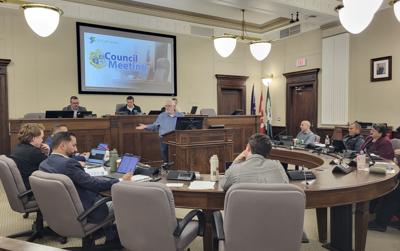
St. Catharines city councillors listen to a presentation from Gilles Marceau, one of 25 delegates who spoke about amalgamation during a special council meeting on governance reform on Monday. Marceau did not take a position on amalgamation but asked for evidence-based facts for people to trust the system.

Will amalgamation water down citizens’ voices and dilute democracy?
Or will it give Niagara a larger voice and more efficiencies?
Residents for and against amalgamation argued their cases in front of St. Catharines city council Monday during a special meeting on governance reform that packed council chambers.
Twenty-five people made presentations over the four-hour meeting before councillors weighed in with their thoughts. The majority of speakers were against, with several for and a few who didn’t take a position either way.
The issue was thrust into the spotlight after Niagara Region Chair Bob Gale sent a letter to the minister of municipal affairs and housing saying there is an “urgent” need for governance reform in Niagara and he is contemplating changes “to maximize efficiencies and benefits.” He sent another letter to Niagara’s 12 mayors on Feb. 19 requesting their thoughts on a one-or four-city model by March 3.
“I object strongly to how the chair of regional council has handled this, with no proposed public consultation and with two weeks for feedback before recommending that the province sweep us all into a megacity or into four cities,” said resident Kate Werneburg.
“This took most ordinary Niagarans completely by surprise. This is not a movement that’s come from a groundswell of support, a grassroots issue. This has instead been imposed on us by higher powers. All of this is undemocratic.”
Werneburg said she couldn’t see how the proposal benefits St Catharines or its neighbours across the region when they know from studies like those done at the Fraser Institute that amalgamation does not save money.
She said instead, amalgamation limits people’s involvement in their own governments.
“Less representation in government gives the balance of power to the majority and stymies minority voices.”
Resident Saleh Waziruddin had similar concerns about representation, saying amalgamation will benefit developers.
“When there are more councillors and more representatives, our voices count more, organized people have more power. When there are fewer officials, organized money has more power because it can focus on lobbying fewer people,” he said.
“Amalgamation waters down our votes but doesn’t water down developers’ millions, it amplifies it.”
Resident Ann-Marie Zammit said forced amalgamation is a power grab to dilute democracy and allow developers to profit off the land in Niagara.
Zammit said while constituents extend a level of trust, mayors cannot operate in a vacuum and make unilateral decisions such as amalgamation.
“Amalgamation is not the answer. It should not even be an option on the table, and taking away elected leadership from constituents won’t result in any significant savings and especially won’t increase accountability from our government.”
But Penny Dickinson, a senior citizen with a background in tourism marketing, said St. Catharines residents will have a far bigger voice at the provincial funding table if there are 500,000 people versus 135,000.
She said if they’re going with their hands out now, the province isn’t going to pay attention because it has bigger fish to fry, but a larger population will mean something.
“I think when people talk about their fears, I think the fear of not amalgamating should be just as great as the fear toward amalgamating,” she said.
Resident Allen McKay said he doesn’t believe the current structure of a two-tier system is serving Niagara residents as effectively and affordably as it could.
He said a Berkeley consulting report from 2000 identified many of the same issues that Niagara is dealing with now — duplication among tiers, blurred accountability, inefficiencies and barriers to co-ordinate planning.
“Three decades later, taxes are still rising faster than inflation, infrastructure deficits persist and accountability remains layered and unclear. If that doesn’t suggest a need for structural change, then I don’t know what does.”
Resident Bryan Blue said there have been plenty of discussions and opportunities to make the current system run effectively and efficiently “and it’s not.” He said he wants to see better services, stronger competitiveness and reduced duplication.
Blue said when accountability is shared, clarity suffers, and when clarity suffers, timelines extend. And when timelines extend, costs rise.
“A more consolidated structure offers something powerful — one accountable authority, one budget, one plan, one clear line of responsibility. That clarity alone improves service delivery,” he said.
“For residents of St. Catharines, that means fewer handoffs and more direct answers. And for businesses that means predictability.”
But some residents warned of drawbacks from amalgamation based on living in other areas.
Resident Vicki-Lynn Smith shared her experience in Orleans in the City of Cumberland before being amalgamated into Ottawa in 2001. She said Cumberland had a surplus and Ottawa had a deficit. Snow removal service went down for her and taxes went up.
“There’s no benefits. And anywhere I’ve looked, anybody I’ve talked to that’s gone through this, not one person has ever said there’s benefits in this.”
Trish Houtby grew up in Fenelon Falls, which amalgamated into Kawartha Lakes in 2001. She said the negative impacts have led people to call the new body the “City of Kawartha Mistakes.” She said people don’t feel taken care of in the same fashion that they did when they were separate entities.
“The positive impact of joining a larger city has never truly been realized by the locals,” she said. “Often the larger cities receive new shiny things and the small hamlets are left out.”
Houtby said she doesn’t fear change but fears doing things for the wrong reason.
“I’m not here for the quick dopamine hit of saving a small amount of money now, only to have the cost of my services rise dramatically due to poor thought and planning,” she said.
“In my personal opinion, amalgamation makes it easier for the province to download more things and I just don’t see how that would benefit us. Just because our current premier wants to push things through, let’s not become the next Kawartha Mistakes.”
A recording of the meeting Monday will be submitted to the regional chair, the Ministry of Municipal Affairs and Housing and local MPPs.
Residents will get another opportunity to address council on the issue. Councillors passed a motion to have an additional special council meeting scheduled in the near future so residents and community partners who didn’t speak Monday can present their views.
The city will also be collecting feedback on its Engage STC web page at the request of council.

No comments:
Post a Comment