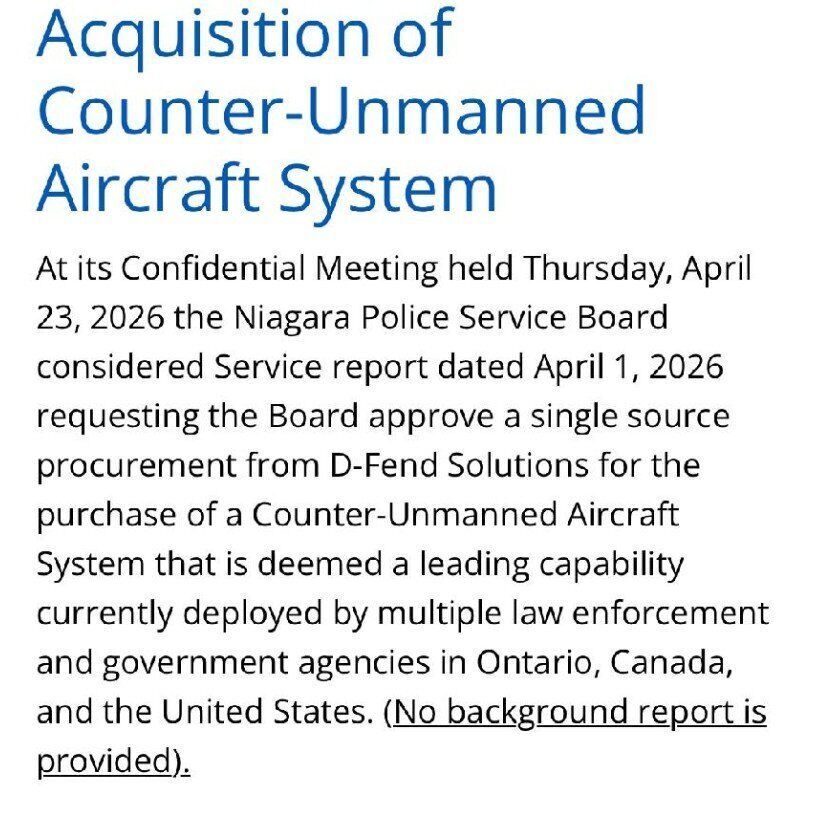
The board of the Niagara Regional Police has approved a quote to purchase counter drone technology from an Israeli defence company for $534,650. The Police Board’s public agenda for its May 28 meeting and minutes for its April 23 meeting originally included the name of the company, D-Fend, but the agenda and minutes were altered and replaced with a version that has scrubbed the company name from the public record.
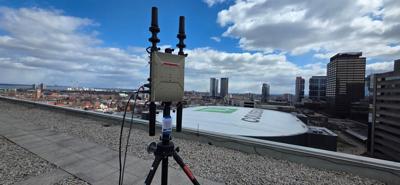
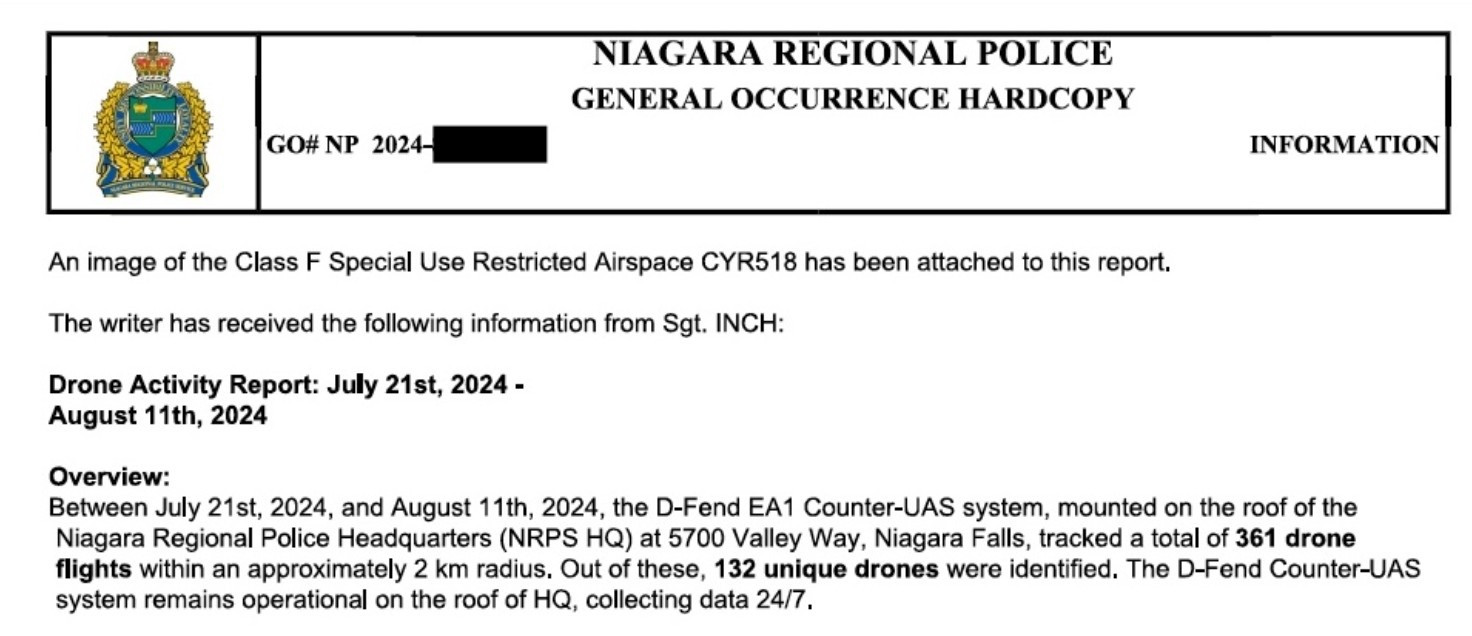
A general occurrence report from 2024, obtained by The Pointer, shows Niagara Police was using the D-Fend unmanned anti-drone aircraft system on the roof of police headquarters that summer.
Now, the plan to purchase the half-a-million-dollar system comes after a major Niagara Region Police budget increase passed this year by Niagara Regional Council on February 13.
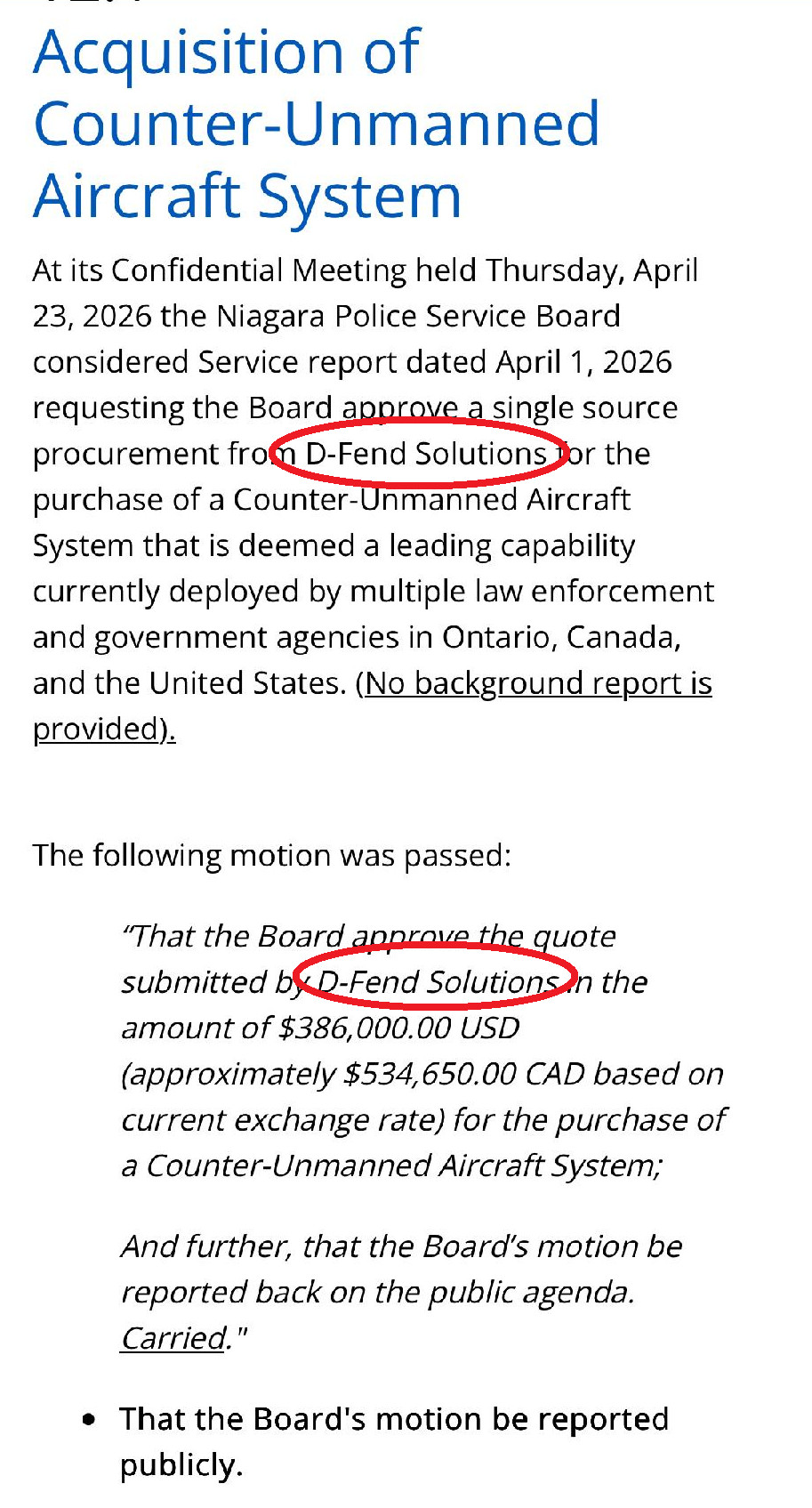
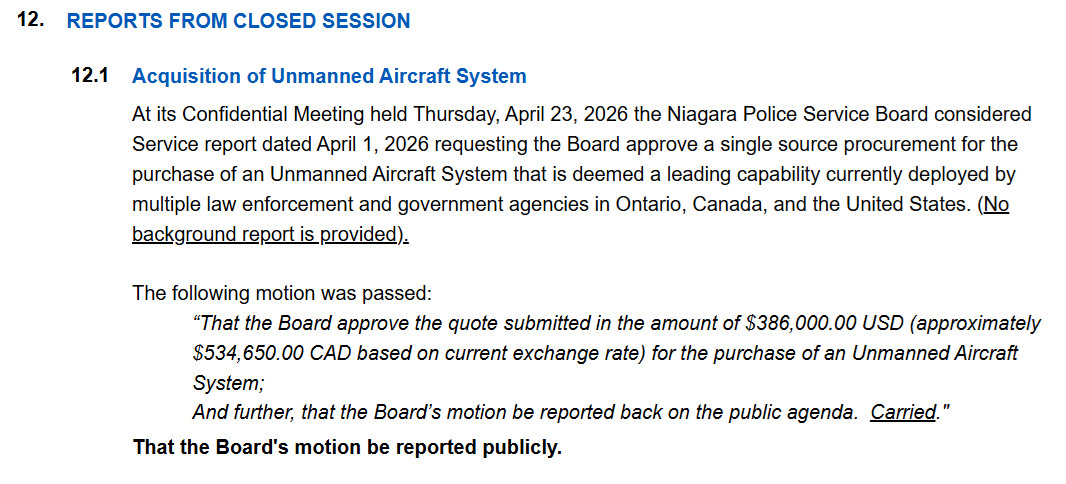
Top: The description on the original agenda and minutes for the May 28 meeting posted on the Niagara Regional Police Service Board website included the name of the Israeli company, D-Fend, that the force plans to procure an anti-drone system from; Bottom, some time before June 8, the name of the company was removed from the agenda, and the minutes for the April 23 meeting were altered to exclude the name.
(Niagara Regional Police Service Board)
Comparison of the original agenda item on the May 28 Police Board meeting, to the altered version reveals other small changes in the language of the motion including the technology that the Niagara Police plans to purchase. “Counter-unmanned aircraft” was changed to “unmanned aircraft system.” The Niagara Regional Police Service Board met in-camera April 23 to discuss the purchase. There is no public information on what was discussed, but the motion to procure the system for more than $530,000 was included on the “closed session” in-camera portion of the agenda for the May 28 Board meeting.
When Saleh Waziruddin, leader of the Niagara Region Anti-Racism Association, noticed that an altered version of the agenda and minutes had removed the name of the private Israeli defence company that had appeared in the original version, he said the alteration immediately raised concerns. “This is another instance of the NRP gaslighting the residents of Niagara,” he said to The Pointer on Monday. “Even if drones were a massive issue in Niagara, why would the budget for this need to be this big, and why would the NRP need to redact the name of the company?”
Waziruddin emphasized that, “There is already concern about policing and drone technology being weaponized against racialized communities and those who demonstrate or speak out against the genocide in Gaza. The police have already been pressuring members of the Niagara Palestine Coalition to talk to them about pro-Palestine activism.”
The use of anti-drone technology by government and law enforcement is a grey area in policies around the world, with little information from Niagara Police about how the unmanned aircraft system would be used, the potential gathering of data or private information, and the possible use against particular communities or groups, and in specific areas.
Critics have warned that in the wrong hands, such technology could be used to target already marginalized demographic groups.
Friction between Niagara’s racialized communities and the Niagara Police is not new.
The Service’s own data shows that Black residents are subjected to use-of-force by officers at disproportionately high rates, among the worst rates of disproportionate use in Ontario. Black residents have force used against them by Niagara police at nine times the rate compared to how often it is used against the general population. In December, Justice Amy Ohler acquitted a man of drug charges because it was found that Niagara police officers engaged in racial profiling to make the arrest. She said the use of “race-based decision making” damages the integrity of the criminal justice system.
The single-source procurement process for the anti-drone system also concerns Waziruddin. According to the Niagara Police Board’s procurement policies, “single-source,” or non-competitive procurement processes, can only be conducted through direct negotiation methods if there is a lack of the required good available on the market, when exclusive rights are held by the supplier, for compatibility purposes, or there are no reasonable alternatives or substitutes.
Licensed RPAS pilot (remotely piloted aircraft) and transportation analyst Sabrina Hill raised her own concerns about the procurement process with The Pointer. “In my work, every decision has to be grounded in clear, defensible evidence — that’s the standard across the public service. Yet NRPS is asking the public to accept a $500,000 surveillance purchase without showing the data to justify it. When that evidence isn’t there — or isn’t being shared — it raises serious questions about the process, the effectiveness of the technology, and ultimately the motivations behind the decision.”
D-Fend’s EnforceAir-Type product includes Radio-Frequency take over. It can detect hostile drones, emit a radio frequency, take over the drone, and set it down in a safe location. Canadian companies like Dominion Dynamics and Sapper Labs, offer advanced anti-drone defences already. Several Canadian companies are developing and testing sovereign cyber-takeover systems and radio-frequency mitigation systems, but Canada does not currently have home-grown radio frequency counter-drone technology, according to reporting by Canadian Affairs.
Niagara Regional Police spokesperson Stephanie Sarbourin provided a written response to The Pointer’s questions about the procurement: “Given the unique environment of Niagara Falls, including its proximity to international borders, critical infrastructure, high visitor volumes, and restricted airspace, the Niagara Regional Police Service regularly assesses emerging technologies that may enhance public safety and operational effectiveness.”
According to a “General Occurrence” report from the summer of 2024, Niagara Police was already using, and could possibly still be using the D-Fend anti-drone system. The report shows it was operating on the roof of Niagara Police headquarters between July 21 and August 11 that year, when the technology tracked 361 drone flights within an approximately 2-kilometre radius of the building, during the roughly three-week period. The report, at the time, said the “system remains operational on the roof of HQ, collecting data 24/7.”
This raises numerous questions about privacy and clandestine surveillance of the public without their knowledge. The Pointer is investigating the report, when D-Fend’s technology was first procured, how long it has been used for, and whether the public was informed of the procurement and the program prior to the installation of the system on the roof of police headquarters.
Following the release of the agenda for the May 28 Police Board meeting, and local media reports on the anti-drone system, a Facebook page under the account name “Niagara Region Neighbourhood Watch Group” had a mix of posts about the procurement.
“The area around Niagara Falls is restricted airspace that is frequently violated. With the number of tourists the area is a target for bad actors and this technology will be key for protecting large events,” one user wrote.
Another replied to the post that, “those sound like prov and fed issues - not $500,000 of my property tax dollars.”
Another posted, “½ million for something to play with and invade our privacy. To fly around and on your property they need a search warrant. Has the city tax payers approved this spending, I think with that amount it should be approved or NOT APPROVED by the citizens of St. Catharines. ½ a million could RE-OPEN the YMCA across from Home Depot…”.
Sarbourin said because the matter relates to “policing techniques and operational capabilities, we are unable to discuss specific details regarding the technology being considered, its capabilities, deployment methods, or operational use.”
She said the force follows laws that pertain to the use of such a system. “Any technology utilized by the service is subject to applicable legislation, regulations, governance requirements, and oversight mechanisms to ensure it is used lawfully and in support of community safety.”
Questions about how the vendor was selected and why single sourcing was required, were not addressed.
Hill, who has a background in criminal defence, said “From a policy standpoint, you don’t deploy advanced surveillance tools first and justify them later — yet that is what this situation looks like.”
When Waziruddin found the alterations to the public agenda and the minutes, he “got curious why the NRP would bury the name of the company they were planning to spend half a million dollars on by scrubbing it from the internet.”
The company’s history shows direct connections to the controversial Israeli military. All three of D-Fend’s original founders are Israeli Defence Forces veterans. Zohar Halachmi (Chairman and CEO), Assaf Monsa (Chief Technology Officer and VP of R&D), and Yaniv Benbenisti (President and Chief Product Officer) have all served in the IDF, which is mandatory for most Israeli citizens at the age of 18.
D-Fend is headquartered in Ra’anana Israel. The company raised roughly $65 million to $67 million from prominent Israeli and international venture capital funds to get its start back in 2016. The company’s website claims the start-up began in founder Halachmi’s garage. In 2022, Aviation Week Intelligence Network announced the start-up’s debut into the public market. Today, the company operates as a critical tier-one technology provider for Israeli Defence forces. Motorola Solutions just signed an agreement to acquire D-Fend for $1.5 billion (US). The primary beneficiaries of the acquisition are the chairmen of the board of the company.
The company founder has admitted to partnering with the Israeli military. Halachmi once told reporters in a 2024 C-Tech Calcalist investigation that he was working on repairs to the EnforceAir-type system so that he could loan it to the Israeli Ministry of Defence to help in the Gaza war effort. This comment came in response to malfunctioning D-Fend systems sold in the United States. The company had to admit that 15 units were sent back to the manufacturer.
Although D-Fend’s website claims reduced false alarms, counter-drone technology can malfunction. Reuters reported that on March 1, 2025, U.S. Navy testing of counter-drone technology caused some flights to terminate their landings near Washington National Airport. U.S. Senator Ted Cruz said in a hearing that the malfunction was caused by the counter-drone aircraft that utilize the same spectrum band as the alerting systems used by other aircraft like helicopters and planes. Flight crews have intercepted faulty warnings of aircraft nearby, according to the American Federal Aviation Administration and Cruz. The report did not name the company whose technology was being tested.
Technology start-ups, like D-Fend, have reportedly signed lucrative contracts during Israel’s ongoing military campaign in the Gaza strip. D-Fend systems are intended and have historically been used against Palestinians primarily in Gaza. Fortune Business insights identified D-Fend as a key player in the publication’s industry analysis of the Counter-Unmanned Aerial Systems (UAS) market size. A D-Fend webpage advertises being located in “a G7 country with active borders.” The name of the country is not mentioned.
Niagara Police’s drone-protection spending comes after a controversial budget increase. The force’s 2026 operating budget was approved at $236.9 million, an 11.5 percent increase over the previous year. While the Police Board reduced the initial request by senior police leadership, delaying the hiring of 10 new officers, the final budget remained well above the decrease Niagara Regional Council had asked for.
To narrow the gap, the Niagara Police’s revised budget proposal identified cuts and deferrals across several areas. Among them was a proposed $473,611 reduction to the Modified Work Accommodation Program, which supports injured employees, an amount only slightly less than the value of the D-Fend contract. The force also proposed eliminating its Employee Future Benefit Reserve Fund and delaying certain Digital Evidence Management initiatives.
Another delayed initiative is the Niagara Police’s adoption of body-worn cameras (BWC) which have been commonly used by police departments across Canada for half-a-decade, to ensure transparency and accountability, and protect accurate evidence in court cases.
The 2026 capital budget was supposed to include body camera purchases. Earlier this month, the board announced $6.8 million in capital spending, mainly to fix equipment and vehicles. This deferral, along with 16 other delayed or cut program spending line items, came in-spite of positive response from the public in using body-cameras to increase public trust.
According to the Niagara Police’s own webpage on the BWC program, “From March 7 to April 4, 2025, NRPS led a comprehensive community consultation that included in-person and online engagement across multiple locations.” This included 2,780 residents who participated and provided favourable feedback on the use of body cameras. The same webpage has yet to post any update on the recently announced delay in the program and no timeline is mentioned on when Niagara’s citizens can expect BWCs to be implemented.
Despite concerns raised by councillors over rising costs, Niagara Police Board member Kevin Gibson defended the spending plan. Speaking publicly in December, he argued the force could face budget constraints in future years, framing the increase as a precaution against potential future cuts rather than pointing to an immediate operational need.
Critics, like Wazirudden, challenge the necessity of the anti-drone purchase at all. Niagara Police has not publicly outlined the scale of the drone threat in the region, or explained why the new technology is required.
In Niagara Police’s 2026-2029 Action Plan: Emergency Preparedness and Response strategy, drone use is mentioned twice. Once as an “Activity for consideration” in order to enhance search and rescue and other police operations, and once to “leverage drones and AI to supplement mapping.” The purpose of and need for counter drone technology is not mentioned in the strategic plan.
D-Fend’s “non-kinetic counter-drone technology” does not have any easily definable capabilities that match Niagara Police’s stated purpose for investing in the system.
“NRPS appears to be deploying technology that can interfere with aircraft, but the legal authority to do that in Canada is far from clear,” Hill stated. “There’s a major difference between detecting a drone and taking control of it — and that comes with real risks. I’ve raised this with Transport Canada, but the public still hasn’t seen confirmation this is allowed. So, the question is simple: can police in Canada hijack a drone — and if they do and it crashes, who is held responsible?”
She explained that in Canada drones are legally treated as aircraft under federal aviation law. There is no established authority permitting municipal police to take control of them while in flight.
“The current regulations focus on safe operation — not interception — which means any attempt to interfere with a drone raises serious legal, jurisdictional, and liability concerns. We are talking about the possibility of a police-initiated loss of control of an aircraft over an urban area — that risk has not been adequately addressed in public.”
For residents and community organizers like Waziruddin and Hill the major concern is the lack of transparency surrounding the purchase of the anti-drone system. Waziruddin argues the need for counter-drone technology has not been properly justified, and he has serious concerns about the procurement process. “This technology is tested out on Palestinians before it is used on us.”
Israel and Canada maintain free-trade, despite the boycott, divest, and sanction (BDS) activism that has grown across North America since even before the start of Israel’s intensified actions in the Gaza strip and Lebanon. The federal government uses the “Policy on Prioritizing Canadian Suppliers” for non-defence procurements to promote domestic industries. However, for military and defence, the government was supposed to freeze approving new arms export permits to Israel that are suspected to be used in the conflict in Gaza.
Despite this 2024 policy, Canada continues to sell arms to Israel. Arms Embargo Now, a coalition of 400 trade unions, religious organizations, and civil society groups, published a report in November of last year which revealed how Canadian-manufactured military material gets sold to the United States first and then gets sold and shipped to Israel. For example, the report exposes how the Mississauga-based manufacturer Honeywell Aerospace sold aircraft parts, power, thermal management, and controller systems that ended up in Israel.
Bill C-233 is intended to close the loophole, but it currently sits at the second reading stage in Parliament. It faces opposition from the Conservatives. The party opposes the Bill on the grounds of the U.S. possibly interpreting it as “a direct threat to [American] defence and security.” Palestinian security and defence are not considered in the Opposition’s statements. The federal Conservative’s opposition to Bill C-233 comes despite American arms sales that likely break international law, according to experts.
Waziruddin wonders why the name of the Israeli company was scrubbed from the agenda and the Police Board’s meeting minutes. “It makes you wonder how else are the police gaslighting the public, and what they have already gotten away with that we don’t know about.”