Surprise Attack! Revolution carried through by small conscious minorities

Surprise Attack! Revolution carried through by small conscious minorities
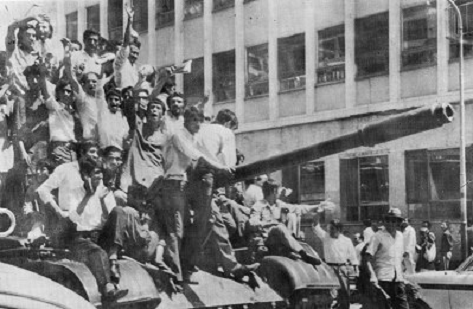
Kabul in the Republican Revolution of 1973

Wednesday, January 2, 2008

reactionary revolutionaries and revolutionary reactionaries

reactionary revolutionaries and revolutionary reactionaries

by Saleh Waziruddin

These days we're seeing the labour, leftist, and socialist/communist movements confused bewildered and confused around the question of the rights of countries facing colonization and occupation. there is really no need to be confused, the issue is very simply that imperialism is objectively bad for all of us and fighting imperialism is good for all. but the successful propaganda against those who resist imperialism as being reactionary and violent, which is based on fact yet also a denial of the most fundamental fact of what a violation of rights imperialism is, as well as the argument for defending the imperialist countries when in fact the wars are destroying the imperialist countries and their people, has fooled a lot of people on the left. we find leftist repeating the imperialists propaganda against those who are resisting imperialism as fascists and reactionaries.

this is not a new problem, socialists during world war i saw their parties fall into the same trap. it was inevitable that reality would make these ideas unsustainable, and everything came crashing down.

here are some quotes from lenin and stalin on this problem

Lenin in the discussion on self-determination summed-up

It described the Irish rebellion as being nothing more nor less than a "putsch", for, as the author argued, "the Irish question was an agrarian one", the peasants had been pacified by reforms, and the nationalist movement remained
only a "purely urban, petty-bourgeois movement, which, notwithstanding the sensation it caused, had not much social backing". ...

It is to be hoped that, in accordance with the adage, "it's an ill wind that blows nobody any good", many comrades, who were not aware of the morass they were sinking into by repudiating "self-determination" and by treating the national movements of small nations with disdain, will have their eyes opened by the "accidental" coincidence of opinion held by a Social-Democrat and a representative of the imperialist bourgeoisie!! ...

The term "putsch", in its scientific sense, may be employed only when the attempt at insurrection has revealed nothing but a circle of conspirators or stupid maniacs, and has aroused no sympathy among the masses. The centuries-old Irish national movement, having passed through various stages and combinations of class interest, manifested itself, in particular, in a mass Irish National Congress in America (Vorw&aumlrts, March 20, 1916) which called for Irish independence; it also manifested itself in street fighting conducted by a section of the urban petty bourgeoisie and a section of the workers after a long period of mass agitation, demonstrations, suppression of newspapers, etc. Whoever calls such a rebellion a "putsch" is either a hardened reactionary, or a doctrinaire hopelessly incapable of envisaging a social revolution as a living phenomenon.

To imagine that social revolution is conceivable without revolts by small nations in the colonies and in Europe, without revolutionary outbursts by a section of the petty bourgeoisie with all its prejudices, without a movement of the politically non-conscious proletarian and semi-proletarian masses against oppression by the landowners, the church, and the monarchy, against national oppression, etc. -- to imagine all this is to repudiate social revolution. So one army lines up in one place and says, "We are for socialism", and another, somewhere else and says, "We are for imperialism", and that will be a social revolution! Only those who hold such a ridiculously pedantic view could vilify the Irish rebellion by calling it a "putsch".

Whoever expects a "pure" social revolution will never live to see it. Such a person pays lip-service to revolution without understanding what revolution is. ...

We would be very poor revolutionaries if, in the proletariat's great war of liberation for socialism, we did not know how to utilise every popular movement against every single disaster imperialism brings in order to intensify and extend the crisis. If we were, on the one hand, to repeat in a thousand keys the declaration that we are "opposed" to all national oppression and, on the other, to describe the heroic revolt of the most mobile and enlightened section of certain classes in an oppressed nation against its oppressors as a "putsch", we should be sinking to the same level of stupidity as the Kautskyites.

Stalin in foundations of leninism

The revolutionary character of a national movement under the conditions of imperialist oppression does not necessarily presuppose the existence of proletarian elements in the movement, the existence of a revolutionary or a republican programme of the movement, the existence of a democratic basis of the movement. The struggle that the Emir of Afghanistan is waging for the independence of Afghanistan is objectively a revolutionary struggle, despite the monarchist views of the Emir and his associates, for it weakens, disintegrates and undermines imperialism; whereas the struggle waged by such "desperate" democrats and "socialists," "revolutionaries" and republicans as, for example, Kerensky and Tsereteli, Renaudel and Scheidemann, Chernov and Dan, Henderson and Clynes, during the imperialist war was a reactionary struggle, for its result was the embellishment, the strengthening, the victory, of imperialism. For the same reasons, the struggle that the Egyptian merchants and bourgeois intellectuals are waging for the independence of Egypt is objectively a revolutionary struggle, despite the bourgeois origin and bourgeois title of the leaders of the Egyptian national movement, despite the fact that they are opposed to socialism; whereas the struggle that the British "Labour" government is waging to preserve Egypt's dependent position is for the same reasons a reactionary struggle, despite the proletarian origin and the proletarian title of the members of that government, despite the fact that they are "for" socialism. There is no need to mention the national movement in other, larger, colonial and dependent countries, such as India and China, every step of which along the road to liberation, even if it runs counter to the demands of formal democracy, is a steam-hammer blow at imperialism, i.e., is undoubtedly a revolutionary step.

Lenin was right in saying that the national movement of the oppressed countries should be appraised not from the point of view of formal democracy, but from the point of view of the actual results, as shown by the general balance sheet of the struggle against imperialism, that is to say, "not in isolation, but on a world scale." (See Vol. XIX, p. 257)[1] 


Saturday, September 1, 2007

An interview with UNITE-HERE ex-hotel worker and community organizer (Rebel Youth)

An interview with UNITE-HERE ex-hotel worker and community organizer
Youth on the Front Lines
By Asad Ali
(Rebel Youth, Fall/Winter 2007)

Have you ever eaten at a restaurant, or stayed in a hotel? If you answered yes you’ve probably used part of Canada’s $1.5 trillion tourism industry, over 40% of which is in Ontario and half of that (1) enters through Niagara, leaving Niagara Falls with a $700 million tourism industry of its own (2). According to StatsCan the Canadian tourism industry has an 18% profit rate (3), but is classified as the lowest paid (4). The second biggest employer of hotel workers in Niagara Falls (5) is Canadian Niagara Hotels (CNH), and the hotel workers with UNITE-HERE 2347 at the flagship Sheraton at the Falls have been fighting to defend their basic rights and contract since CNH bought it in 1993.

In 2006 an arbitrator was so affected by the disparity between the union’s and management’s proposed contract that he ruled that UNITE-HERE’s proposal would become the actual contract. CNH has continued its campaign of intimidation, however, and attacked the right to an 8-hour shift by splitting it so that the last 2 hours have to be done after a 2-hour window. Michelle Hemmingson, an activist and steward at the hotel, was fired and is now helping to keep the fight going as an organizer with Local 2347. Ethan Clarke is the Community Organizer for the local.

RY: What are some of the ways you’ve gotten support?

MH: I delivered a speech to some of the other union locals. They were really disgusted with how I was personally treated. They thought our (situation) was really bizarre and they realized that if we didn’t gather more of the other hotels they would become very similar. CNH is leading the way, the other ones follow in their footsteps

RY: Do the people working at CNH see it as the flagship?

MH: They know that their wages are much better off than anybody because when we get it (the contract) settled, the other ones will bump them up a little bit just to stay within reach.

RY: What’s been the role of younger members in the hotel?

MH: In the hotel industry in the summer it’s really busy and they do hire a lot of students. In housekeeping we have maybe 10 senior girls who have been there 9 or more years. Management would expect more from seniors. They know the seniors are staying, they want them to be above standard. But they know with the younger ones they can just use them. If they don’t do perfect that's fine, they’re just here for one season.

RY: How did this effect getting everyone to work together?

MH: Most of that was done by the more senior people who stuck around because we do it (arbitration) in the off season in January, but it did drag on until July. They said “here’s our (management’s version) collective agreement, if you sign it we’ll give you a $100 signing bonus”. So they brought in the Ministry of Labour to hold the vote, and I know the people inside said why would we want to vote yes on this if we can take a chance and actually get the union contract through arbitration

Management tried not to let us go when we wanted to (go to the management-organized vote). I tried to go on my break at 10:15 and I was told I was only allowed to go on my lunch break, 12:00. There were five of us who were told they couldn’t go and so we all gathered at 12:00 and went together anyway.

RY: When management attacked the union by splitting shifts what are some of the ways you kept members together?

MH: I purposefully worked that shift for a week just to see what it was like. What we tried to do on the inside was get as many members to say “yes I will work a split shift” just to see what they (management) would do. We had maybe ten at the most the first day and after that I think maybe half of them dropped out. People said “we’re sitting here from 8:30 in the morning till 8 at night and we'd like to help but we can't do it.”

When I went there and did my split shift to get the documentation of what kind of work we’d be doing, what they said was “work for six hours and then go off the property”. Couldn’t stay in the lunch room, we had to leave the property. I live in Welland, a 30 minute drive, and I have a four and a half year old son right now, so I would drive home after my shift, eat dinner, and come back. It was really a stretched week for me.

My last 2 hours of work they told me I’d be doing four more rooms. It didn’t turn out that way, there were no more rooms left. There were four of us left and three girls were given the option to either wash down guest room doors on two floors, sweep down the stairs different days, and one day they were to clean the elevator section.

I was given the job to go to the kitchen staff bathroom and clean the bathroom which nobody seemed to have done on a regular basis. It took me two shifts to clean three bathrooms. Their walls were yellow; people didn’t seem to know how to pick up a toilet seat. I don’t know how they got away with it health and safety standards-wise.

How come I clean the bathrooms and other girls are washing doors? And they were like “oh that’s just what you got to do”. They pulled anything they could together. Sometimes we would be waiting 15 minutes just to see what we would do. They didn’t (plan for us to work the split shift) and when I questioned the executive housekeeper at a meeting one time, “how come I can’t do that work from 3:30-5:30, why does it have to be split?”, she said “that’s just the way things are.”

People were really, really annoyed and I think right now it’s the busy season and they had (pressured) everybody to sign saying “I am willing to work 6 hour shifts” (rather then the eight they are entitled to). They’re short staffed again and people are saying “I'm only doing six.”

It’s hard work being a room attendant. “We need you to work eight hours Sunday” but on Monday “oh we only need you for six.” Morning or even at noon they’ll come and ask you, I’m like “no you should have scheduled me, I have a life outside work, people have childcare arrangements.”

Eventually they are going to realize, we should give them 8 hours.

EC: We figured that the difference is $480/month between a 30 and 40 hour week.

RY: What are some of the issues you experience as a woman working at the hotel?

MH: I was on the health and safety committee and being a woman (whenever) I would suggest they should do something differently, it was sort of just like shrug it off, “it’s not a health and safety issue, you shouldn’t really worry about it”. I was like “yeah, it technically is.”

RY: What are some of the reasons people say we have to take a stand here?

MH: What I always hear from the workers is the reason we put up with it is because of the pay. They’re one of the best paying hotels, a lot of them are saying they just want to basically work and go home, they don’t want to deal with the dramas that are going on inside. The majority are saying they just want to come to work and go home and just get their job done.

We have problems where we’re constantly out of sheets, and that puts us behind and they still just say “I just want to come to work and do my job”. Well how can you come to work if you don’t have the proper supplies? But “I don’t want to deal with it” and at the end of the day people stay late just to finish. We don’t know if they get paid or not, they don’t want to deal with the hassle but why work for free?

EC: Part of the contract we’ve been awarded says $100 dollars is to be paid out (to members on signing). CNH’s response was that it’s the union’s contract so the union should pay it (!). One of the most creative responses I’ve ever heard. When the boss takes 100 bucks out of their pocket, and the response is “I don’t want to make trouble”. We did manage to get a portion of the membership to sign a grievance on that.

(The experience with CNH is) slow down, slow down the grievance process. We had one person who got fired for stealing a piece of cake, it took two years to fight that. We do win things, it just takes a long time.

RY: what were some of the ways you were able to member-to-member get people on board for the signing bonus?

MH: I took a sheet and said we’re filing a grievance, we just need your signatures and explained everything to them, and then we got the majority. They thought the union should pay half and the company should pay half, because that’s what they were hearing. I was like “do you realize where the union gets their money from? It’s from your dues, so if you expect your union to pay you it’s like you taking money from your left pocket for your right pocket. The big steel companies they get their signing bonuses, the union’s not paying it. It’s the company who’s making the millions.”

RY: What are some of the first steps you recommend to other people who are in a similar situation?

MH: Don’t go out on a limb on your own, take everything slow. Don’t jump into something (where) you really don’t know what you’re doing. Ask for some training (from a union), ask a union rep definitely. Don’t do anything on the spur of the moment, think of the outcome.

When they rush into it they don’t realize they shouldn’t be doing it on work time when they’re investigating something or trying to get people to sign a petition. They don’t realize they could actually get into trouble from the company. People just starting out don’t realize stuff like that, they’re like “yeah I am doing union stuff I can do it at work”. No you can’t!

It’s very unpredictable. You could think just because you show up at a rally they’re not going to do anything because it was your day off, and then you walk back in and get a 5 day suspension for the smallest thing that you violated in their company handbook.

I would always expect the HR manager to find a loophole. It’s like we won the contract, we won the 8 hour shift: “yeah you can have the eight hour shift but they’re split!” But as you stand together I think you should be able to overcome those obstacles.

RY: What can people do to help?

MH: We don’t want to boycott.

EC: We would like people to go to Niagara Hotels, hear the stories of the workers, let CNH know you care how their workers are treated. If you’re in Niagara Falls talk to the workers directly. If you’re not, write to let the workers know that you’re hearing about their story (5914 Main St., Niagara Falls, ON L2G 5Z8). It can be e-mail (eclarke@unitehere.ca). Also follow our web site (www.niagarahotelworkers.ca/).

RY: What are some of the ways to survive when under attack, any tips you can give our readers?

MH: Just contact a union even if you are not one (a member). First I’d say don’t react by getting angry, trying think of ways to screw the employer, because you don’t want to do that. You don’t want to ruin your chance. Definitely don’t want to be insubordinate, do what they tell you anyway and then think of options that you have like options a, b, or c. Talk to your coworkers then go with the best decision that you guys come up with.

EC: Be strategic and work collectively.

RY: Is there anything else you would like our readers to know?

MH: From what I hear the other ones (hotels) are actually decent employers, management actually works together with the employees. They’re not barking commands, they’re trying to make work a happy little place to be.

RY: They let someone else do the dirty work for them?

MH: That’s exactly it

----
Sources:

1. “Quick Facts Sheet – Deputy Ministers Meeting”, Regional Municipality of Niagara, June 28, 2000.

3. “Cross-sectional analyses of performance and structure for Canada’s hotel industry” (#43), Gaston Levesque, Ministry of Industry, 2003.

4. “Job Quality continues to slide - Canada’s economy sheds another 12,000 manufacturing jobs in May”, Canadian Labour Congress, June 8, 2007.


5. City of Niagara Falls, http://www.niagarafalls.ca/business/business_profile/professional_services.asp

Monday, June 25, 2007

Who ever said anti-imperialist solidarity means solidarity with progressives only? (discussion contribution to Communist Party of Canada Central Convention)

 Who ever said anti-imperialist solidarity means solidarity with progressives only?

By Saleh Waziruddin

(Discussion contribution to 2007 35th Communist Party of Canada Central Convention, this was held back from being printed in the discussion bulletin by the Central Executive until a response was prepared to print side-by-side. Also the footnotes were omitted.)

You can choose your friends but not family. You can't choose who your ruling class invades, yet you still owe them anti-imperialist solidarity. This is like how we can't choose who our boss attacks at work, it might be a Tory or someone bad at their job but we still have to defend their rights because if we let the boss win everyone else is next. This simple idea is Lenin's concept of anti-imperialist solidarity in “Imperialism: the Highest Stage of Capitalism,” solidarity is NOT just with workers and progressives but with all forces targeted by imperialism abroad. Otherwise we and they will be a reserve for the boss in going after one and then the other. This is not because imperialism's targets are automatically progressive, but because of how imperialism works in pitting us against each other.

The Main Political Resolution (see Bulletin #1) is dogmatic about anti-imperialist solidarity, especially point #21 where it not only opposes solidarity with Iran's government just because it is targeted by imperialism (not reason enough?!) but puts words in the mouths of people like me saying we must think the Iranian government is pro-worker or progressive since we are calling for support with it, as if anti-imperialist solidarity is only for progressives! The Resolution rightfully declares solidarity with Latin American countries opposing imperialism, who themselves publicly support Iran's government, but conspicuously leaves out forces in Iraq and Afghanistan in hot battles with imperialism and giving it a run for its money.

This confusion about imperialism is part of a growing divide in the communist and progressive movement. The Lebanese CP recognizes Hezbollah and the Palestine People's Party recognizes Hamas as part of the anti-imperialist resistance and give it armed support even though Hezbollah and Hamas are not progressive1, and the Syrian CP2 called the Iranian election a victory for anti-imperialist resistance3. Not just communists: the ALBA countries (Venezuela, Bolivia, Ecuador, Cuba, Honduras under Zelaya, Nicaragua, and three Caribbean countries) who the Political Resolution is in solidarity with, and Brazil, have publicly supported Ahmadinejad and the Iranian government for being in imperialism's cross-hairs4.

On the other hand, some other communist parties have called these anti-imperialist forces a threat to the working class5. Recently People's Voice carried an interview by Junge Welt with CC First Secretary of the Tudeh Party6 where he correctly pointed out it is dogmatic to criticize the Iranian opposition for not being purely working class, but why shouldn't the same anti-dogmatism not apply to the Iranian government's anti-imperialism? In the interview the Tudeh leader denigrates Iran's refusal to give in to imperialism by comparing it with the Taliban's combat against imperialism, without giving a reason for why this isn't anti-imperialism. Isn't it objectively anti-imperialist (and natural!) when you are actually fighting armies occupying your country, or are under threat of invasion but hold on to sovereignty anyway? Yes, there are limitations to these forces, but who can deny that they are not surrendering to imperialism?

Iran's government and its President Ahmadinejad in particular are being viciously attacked in a propaganda campaign like the Iraq WMD claims. Even some communists have swallowed the lie that Ahmadinejad is a holocaust denier despite him protesting “I'm not saying it didn't happen”,7 or that he has threatened Israel, even though leftists unsympathatic to Ahmadinejad such as professor Juan Cole have refuted the latter as groundless8. In the recent interview Tudeh's leader was asked point-blank about these accusations but he didn't refute them. Tudeh Party's 2005 statement repeats the canard that Ahamdinejad called for “wiping Israel off the map.”9

At the Mexico-Canada-US Peace trilateral in October the Tudeh representative said that Iran wants to conquer the Islamic world. This is not something the Iranian government has said and simply doesn't have the means to do, although anyone concerned about someone conquering the Islamic word should look no further than the US which not only has the means but is occupying Iraq and Afghanistan, bombing Yemen, Somalia, and Pakistan, declaring Syria and Iran to be next, and threatened Pakistan's government with being “bombed into the stone age!”10 Let's get realistic about who is a threat to the Islamic world let alone the whole world.

In Canada we're not only subject to anti-Iranian war propaganda that it's our duty to counter, but Canada has exceeded the UN's sanctions against Iran despite Iran's compliance with the nuclear non-proliferation treaty. Canada has banned direct air links with Iran and forbidden Iranian Cultural Centres11, which has nothing to do with nuclear weapons but isolates our peoples from each other. As Leninists it's our duty to break open this blockade, instead of joining our ruling class in condemning Iran's government.

Anti-imperialist solidarity is being counter-posed to solidarity with workers. British labour unions backed out of a resolution for immediate withdrawal from Iraq, a turn-around they credited solely to Abdullah Muhsin of the Iraqi Federation of Trade Unions who is also of the Iraqi CP, whose open letter said withdrawal would be “bad for my country, bad for emerging progress forces, a terrible blow for trade unionism....”12. We should reject this kind of “solidarity”.

I propose that we replace point 21 of the Main Political Resolution (see Bulletin #1) with:

“We also express our solidarity with Iran which is the target of a campaign of slander and misinformation portraying it as a threat to other countries, as well as under UN sanctions despite complying with international treaties, and additional sanctions by the Government of Canada that make travel and contact between peoples of the two countries difficult.

We convey our revolutionary solidarity with the anti-imperialists in Iraq and Afghanistan resisting direct occupations by NATO countries including Canada, some of the most powerful and vicious military forces in human history. The successes of the resistance are a crisis for for the same ruling class we struggle against.”

1For LCP see “Amid the bombs, unity is forged”, Herbert Docena, Asia Times Online, Aug. 17, 2006 (http://www.atimes.com/atimes/Middle_East/HH17Ak02.html); for PPP see “Deluge de feu sur le people de Gaza”, Pierre Barbancay, L'Humanite, Jan. 7 2009 (http://www.humanite.fr/2009-01-07_International_Deluge-de-feu-sur-le-peuple-de-Gaza)

2Lead by Wis'al Farha Bagdash

3 “Victory for Ahmadi-Nejad, a victory for the resistance option”, Peoples Voice issue 214, Jun. 18 to 24, 2009 (http://www.syriancp.org/ara/index.php?subaction=showfull&id=1245259778&archive=&cnshow=news&start_from= )

4See for example Extraordinary ALBA-TCP statement of Jun. 24 2009 reaffirming “its support for the Islamic Revolution of Iran, the institutions of the Islamic Republic of Iran, and the government of President Mahmoud Ahmadinejad and rejected foreign interference and the smear campaign waged against that sister nation”, available on the Venezuela CP web site http://www.pcv-venezuela.org/index.php?option=com_content&task=view&id=5119&Itemid=98

5See for example South African CP's 10th Congress Resolution calling for struggle against “backward, xenophobic, and fundamentalist ideologies” (http://www.sacp.org.za/main.php?include=10thcongress/res.html)

6“Trust in Iranian Government Shattered”, interview with Ali Khavari, People's Voice Sept. 16-30, 2009

7“Iran's President: I don't deny holocaust”, New York Daily News, Sept. 24, 2007

9“Iranian Regime's Adventurism Gives Imperialists an Excuse to Intervene in Iran”, International Bulletin of the Tudeh Party of Iran, #230 Nov. 2005 (http://www.tudehpartyiran.org/TN_230_Nov05.pdf)

10“We'll bomb you to Stone Age, US told Pakistan”, The Times (UK), Sept. 22, 2006 (http://www.timesonline.co.uk/tol/news/world/middle_east/article647188.ece)

11 “Canada-Iran Relations”, Government of Canada, Aug. 2008 (http://www.canadainternational.gc.ca/iran/bilateral_relations_bilaterales/canada-iran.aspx?lang=eng&menu_id=8&menu=L)

12See Steve Warwick's, chair of UNISON Labour Link committee, report to the Labour Party conference of 2004 which includes the letter from Muhsin, available online at http://www.unison.org.uk/acrobat/B1608.pdf, the open letter is also available separately at http://www.unison.org.uk/acrobat/B1571.pdf

Sunday, January 14, 2007

Protesters support the 'Secret Trial Five' (Kitchener Record)

 Nadeem Lawji says he was outraged when he learned that Canadian officials could imprison suspects for years without laying charges against them.

(Copyright (c) 2007 The Record (Waterloo Region). All rightsreserved. )

Monday, November 13, 2006

Naming names: Mispronunciations, assumptions cause some to consider changing their monikers (Pittsburgh Post-Gazette)

 L.A. JOHNSON

A name pronounced is the recognition of the individual to whom it belongs. He who can pronounce my name aright, he can call me, and is entitled to my love and service. -- Henry David Thoreau 

Saleh Waziruddin's name routinely gets mangled -- as gnarled as a Mercedes grille in a crack-up with a Mack truck.

Some have twisted his Arabic name, Saleh, into Saul, Solid, Salad and even Slutch.

Slutch?

For the record, his name is pronounced (SA-leH Wa-ZEER-ud-DEEN).

When he has introduced himself over the phone in political circles, some have misheard him, mistaking him for former Pittsburgh city official Sala Udin and offering him a hearty, "How are you doing, councilman?"

"I can't say there haven't been times where it was to my advantage not to make the correction," says Mr. Waziruddin, 28, of Wilkinsburg. He often obtained the information he was seeking or had his call transferred more quickly when he was mistaken for the former councilman.

When he momentarily has stepped out of the room at business meetings, some have asked his colleagues how to pronounce his Persian last name and have simply been told, "You don't."

Despite the chronic mispronunciations, Mr. Waziruddin doesn't plan to change his name.

"Changing wouldn't be true to the consciousness of who I am," says the Canadian-born Mr. Waziruddin, who moved to Pittsburgh 11 years ago.

"There are periods when ethnic pride is very high, and people say, 'I'm going to keep my name,' " says Edward Callary, a Northern Illinois University associate professor of English and past editor of the American Names Society's quarterly journal, Names. "Then, in the 19th century it was more common to translate or Americanize your name."

What is in a name? A name can easily roll off the tongue or cause lips to stumble. Names and their perceived meanings can shape or distort identity. Some once considered Sen. Barack Hussein Obama's name a potential political liability in a terror-fearing post 9/11 America. However, now that he's a popular political darling and mulling over a bid for the U.S. presidency in 2008, his is a winning brand name rich in political capital.

For as long as immigrant communities have been coming to America, people have grappled with the idea of changing their names.

Throughout history, some have changed their names because they were difficult to pronounce or to hide their country of origin because of biases toward certain groups, says Stanley Lieberson, a Harvard University sociologist.

"Right now, it's rough having a Middle Eastern name," Professor Lieberson says. "In World War II, if you were German, you sure didn't want to have a German name."

There were times when Irish immigrants dropped the "O' " from their surnames and Italian immigrants omitted vowels at the end of theirs.

"Between a third and 40 percent of American names have been changed," says Edwin D. Lawson, professor emeritus of psychology, State University of New York at Fredonia and past president of the American Names Society. Of the 685,000 who've become naturalized citizens in the past year, about 16 percent have requested a name change, according to United States Citizenship and Immigration Services statistics.

In the eight-county region that includes Allegheny County at its center, about 15 percent of the estimated 1,300 people who became naturalized citizens during the past year asked for a name change.

Of the 506 people who have become naturalized citizens in Pittsburgh thus far this year, about 33 percent have changed their names.

"You can change your name to anything but Jesus Christ," says Keith Anderson, deputy clerk for the U.S. District Court for the Western District of Pennsylvania.

When Sayeh Tavangar became a U.S. citizen in 2000, she thought about adopting an American middle name.

"I couldn't take everybody butchering my name," says Ms. Tavangar, 25, of McCandless.

When she orders a drink at Starbucks, she gives the name Lola to avoid hearing, "Venti soy latte for Siher." The same goes for restaurant waiting lists.

"It's just so much easier," she says.

She vividly remembers her first day of fourth grade in 1990 when she'd just moved to Queens, N.Y., from Iran and didn't speak any English.

"The teacher kept trying to introduce me saying, 'This is the new girl from Iran,' and I didn't even know she was saying my name because she was saying it so incorrectly," says Ms. Tavangar, whom Pittsburgh magazine in January named one of the city's 25 most beautiful people. "I always hated the first day of class."

Her name is pronounced (SIGH-eh TAV-an-jer). She has been called Saiey, Sigh-ee, Sisi, Suheh and Messiah. And more than once, perhaps because of the speed or cadence of her voice, people have thought she said her name was Diane, when she's answered her work phone.

She's given up on correcting most people because they still say it wrong. A supervisor at a previous job never got it right.

"You want to slap them and say, 'How can you not know my name? I've worked here so long,' " she says, laughing.

"Every time I tell people I'm Persian, they say, 'Oh, Peru,' " she says, laughing even harder. "And I think, if this person thinks I'm from Peru, is it worth correcting them? Do I even want to talk to them?"

When she explains that Persia is the former name for Iran, people immediately think of Iraq. Then, the questions begin.

"What do you think of terrorism? Do you have family back there? Do you have anybody in your family who has been involved in that?"

"When they make such a stupid comment, I kind of look at them and think there's no hope," she says. "I just ignore it."

Growing up in New York, she didn't experience people having as much trouble with her name, she says, because New York is more diverse and names like hers are more common. She's proud of her name and doesn't intend to change it.

"Just because I live here and have to deal with this, I'm not going to give up my culture and heritage," says Ms. Tavangar, who serves on the board of the Iranian American Council.

When she has children, she plans to give them "definitely Persian names as well that are very hard to pronounce," she says.

Alex Colon, whose full name is Alejandro Jose Colon Vale (Al-e-HAN-dro HO-zay Ca-LOAN VAL-ay), doesn't yet have children, but to spare his future children the moniker mangling he has endured, he may give them English-language names if they're going to be growing up in Pittsburgh.

"If I lived in Miami or California or New York or someplace like that where I knew they wouldn't have such a hard time with the same name, I might consider giving them Spanish names," says Mr. Colon, 28, of Shadyside.

He moved from Puerto Rico to Orlando, Fla., in 1998, lived in Germany for a time and then moved to Pittsburgh in 2004. When he went to set up his cell phone service, the saleswoman had a difficult time with his name.

"My last name was a big deal for her and why did I have two last names and how do you say the first one," he remembers the woman asking him.

His two first names and two last names prove too difficult for many to pronounce. He's been called Alesandro, Alejandro, with a hard "J," Colon, as in rectal, and Vale like Vail, Colo.

"Isn't that tragic," he says.

So, he goes by his childhood nickname, Alex, and just one of his last names.

"Some people have some sort of exposure to other cultures or they may have heard the name before," he says. "Other times, they just don't get it."

American-born Kamala Ramaswamy (ram-a-SWA-mee) is half American and half east Indian. Her German-Hungarian-Irish mother from Akron, Ohio, gave her and her siblings Indian first names to match their father's last name.

"I have to learn to say THAT?" she recalled thinking as a kindergartner, when she saw her name written out.

People routinely mispronounce her first name, even though it rhymes with the familiar Pamela. She's been called Carmella, Camera, Kuhala, Camille and Camilla, when she studied Russian.

"It's a good call screener," says Ms. Ramaswamy, 38, of West Homestead. "If you can't say my name, I know you don't know me."

She corrects people up to three times, then gives up.

"I know who they're talking about and I might as well just answer," she says. "If I speak to you once a quarter or barely need to talk to you, it doesn't really matter."

What's maddening is the assumptions people make about her because of her name, she says.

She grew up in Brownsville, White Oak and Irwin and specifically mentions that she's a Western Pennsylvania native in job cover letters, because people think she is from India.

"Gee, you speak English good," some have said to her. She jokes she doesn't bother to correct their grammar.

"If you're in a technical area or medical office, they want you on their team because people think you're better," she says.

But when she and her siblings were young, over a number of summers, they each applied for jobs at a local ice cream shop and none of them ever got a call back even though a "Help Wanted" sign remained in the shop window.

In a previous job, a client from Brownsville questioned her about her name saying, "How do you say that name? We just don't get names like that down here."

"What's funny is, that's where my dad had his practice," she recalls.

Some people also seem surprised to learn she's Lutheran and enjoys country music.

While names can be indicative of someone's ethnic heritage, they don't necessarily reveal who someone is, she says. The biggest lesson people need to learn about people and names is simple.

"Don't assume."

First Published November 14, 2006, 12:00am


Saturday, October 28, 2006

We're eager to meet with the FBI to develop protocols (Letter to Pittsburgh Post-Gazette)

Letters to the editor

October 28, 2006 12:00 AM

Pittsburgh Post-Gazette

We're eager to meet with the FBI to develop protocols
The Islamic Council of Greater Pittsburgh delegates from local mosques heartily appreciate FBI Supervisory Special Agent Jeffrey B. Killeen's stated desire to foster mutual understanding with the Muslim community and protect our civil rights ("It's Wrong to Suggest the FBI Targets Those of Arabic Origin," Oct. 21). In the spirit of Mr. Killeen's letter, we have two requests of the FBI that we have made in writing directly but have not received a reply to, and after your publication of his letter we are confident that the FBI will support its stated desires with actions:
1) We would like a meeting with the FBI to develop a protocol for searching mosques without causing an unnecessary disruption of services or intimidation of the congregants. We believe it is possible for the FBI to conduct investigations without putting a cloud of suspicion on our whole community as was done on the June 30 raid of the Light of the Age Mosque. We believe this meeting is consistent with Mr. Killeen's statement that the FBI reaches out to the Muslim community.
2) We would like an inventory of any items removed from the Light of the Age Mosque in the raid that took place on June 30. The provision of an inventory is standard, and we are sure the FBI does not believe Muslims should be singled out to be denied this right.
We look forward to a successful meeting on protocols for searching our mosques as well as a delivery of the inventory, and we look forward to a Post-Gazette story on such positive steps the FBI can take to show that we can believe its assurances about its relationship with your Muslim neighbors.
YUSEF ALI
President
Islamic Council of Greater Pittsburgh Executive Committee
Point Breeze
The letter also was signed by Jibril AbdulHafeez, vice president; Khalid Chatta, treasurer; and S. Saleh Waziruddin, secretary.


Thursday, August 24, 2006

Racial Profiling Doesn't Keep Us Safe From Terrorists (Letter to Pittsburgh Post-Gazette)

Letters to the editor: 08/24/06

August 24, 2006 12:00 AM

Racial profiling doesn't keep us safe from terrorists


The writer of the Aug. 21 letter "Go for It" assumes that racial profiling has been "proven successful in stopping terror threats," is necessary for keeping the writer's family and neighbors safe, and that anyone against it has something to hide or is selfish.
Tell that to Getu Tewolde, one neighbor who was arrested as a terrorist here in 2002 without any evidence. After a yearlong campaign by more of our neighbors, who have nothing to hide in their unselfish outcry against racism, Getu was released and cleared of the terrorism charges.
In the last year newspapers have been full of stories of more of our neighbors of color who have been released after being held since 9/11 without charges because the government admits they were not criminals but victims of roundups. Taking away your neighbors' rights based on race has nothing to do with making anyone safer and everything to do with racist anxieties whipped up by sensational rhetoric and headlines.
Racism hasn't worked in the "war on crime" and the "war on drugs," and it's not working in the "war on terror." Profiling and shakedowns feed into racism and demagoguery; they have nothing to do with protecting anyone from crime, drugs or terrorism, and definitely have nothing to do with spreading freedom and democracy.
If you don't speak out when they come after your neighbors, there will be no one left to speak out when they come after you.
S. SALEH WAZIRUDDIN
Wilkinsburg
The writer is chair of the Anti- Discrimination Committee
of the Islamic Council of Greater Pittsburgh.