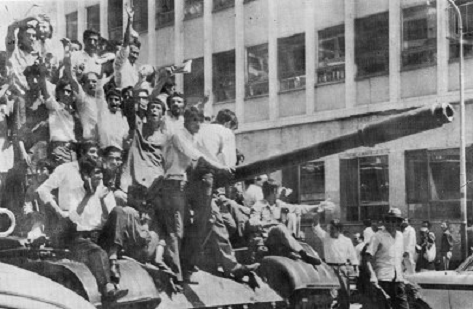
Surprise Attack! Revolution carried through by small conscious minorities

Surprise Attack! Revolution carried through by small conscious minorities
Kabul in the Republican Revolution of 1973

Monday, September 12, 2011

Candidates hit the streets for weekend of campaigning (2011 Ontario Provincial Election St. Catharines riding)

Candidates hit the streets for weekend of campaigning

She may be new to politics, but Sandie Bellows has already figured out a couple of things about pounding the pavement on the campaign trail.


Staying fresh on your feet on the door-knocking rounds requires multiple footwear changes, the St. Catharines Progressive Conservative candidate has learned.


Bellows was relying on a pair of open-toed wedges Saturday afternoon as she and a team of volunteers canvassed the area where she grew up in the city’s north end.


But she also had a pair of running shoes along with her and a set of shoes with a lowrise wedged heel.

“I rotate all of them,” she said, while knocking on doors in the area of Richelieu Dr. and Niagara St.

“We’re putting a lot of miles on this body. It’s not killing me, though.”


The writ dropped Wednesday for the Oct. 6 provincial election, making this past weekend the first official one of the campaign.


But local candidates said they’ve been actively gearing up for the election for the past several weeks.

“The reception has been fantastic,” Bellows said.


“People like that you stop and talk to them. Even if they don’t like your platform, they’re just happy you’re there to listen.”


While bad blood has already boiled over for candidates running in other parts of the province, St. Catharines candidates reached by The Standard said the mood is much more genial locally.


“St . Catharines has had a tradition over the years of avoiding that ( bad blood),” St. Catharines MPP Jim Bradley said in a phone interview Saturday, after hitting the streets of Port Dalhousie with his campaign team.


“I think it ’s important to have a good debate on the issues, not on personalities.”


Bradley, a veteran of at least 10 campaigns since first being elected in 1977, noted he’s been friends for many years with Bellows and her family.


“We’re friends at the start of the campaign and we’ll be friends at the end of the campaign,” he said.

Neither Bradley or Bellows were planning to do any door knocking on Sunday, opting instead to get out to meet prospective voters at various community events.


“ The intensity will pick up as the election gets closer,” Bradley said.


“ The public is partially engaged right now, but very understandably they have a lot of other things on their minds.”


Communist Party candidate Saleh Waziruddin didn’t get out on the campaign trail over the weekend, but said his message of cutting corporate tax cuts and directing more dollars to health-care has been well received at the door.


“Corporate tax cuts are the root cause of limited resources for hospitals,” he maintained.


The riding’ s other candidates — Irene Lowell of the New Democratic Party, Jennifer Mooradian of the Green party and Dave Unrau of the Freedom Party — could not be reached over the weekend.

Wednesday, September 7, 2011

Left Behind (Pittsburgh City Paper)

https://www.pghcitypaper.com/pittsburgh/left-behind/Content?oid=1457434

Left Behind

In the wake of 9/11, American policy has run roughshod over civil libertarians, anti-war activists -- and public opinion itself

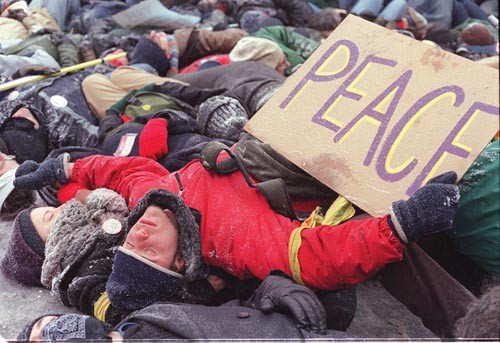
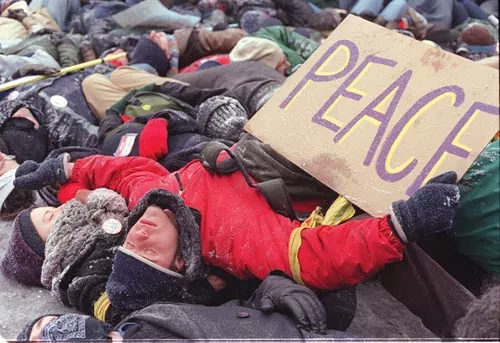
January 2003: Peace protesters held a "die-in" in Oakland to protest the coming Iraq war - PHOTO BY HEATHER MULL
January 2003: Peace protesters held a "die-in" in Oakland to protest the coming Iraq war

Don't ask local activists or civil-liberties experts to pinpoint the worst excess of the "war on terror" since the 9/11 terror attacks. After a decade, they say, there are too many to choose from.

Random searches on public transportation. The surveillance and infiltration of Muslims. The demonization of protest and anti-government sentiment -- unless it comes from the conservative end of the spectrum -- and the use of terror laws used to prosecute activists. The creation of the Department of Homeland Security. The migration of military tactics to civilian policing. The continued operation of a U.S. prison in Guantanamo Bay -- not to mention the wars in Iraq and Afghanistan that created it.

And those are just the tactics we know about.

"We don't know exactly what's going on," admits Brooklyn College Professor of Sociology Alex Vitale, who tracks government reaction to dissent for the New York American Civil Liberties Union.

 That uncertainty may be the most disturbing development of all. Last week, for example, the Associated Press reported that the CIA and New York City police have been collaborating to monitor and infiltrate Muslim groups and mosque attendees. That's "very troubling," Vitale says -- both for what it says about local police and "for its implications for the CIA." The spy agency, after all, is supposed to confine its intelligence-gathering to foreign countries. "If the CIA is taking part in domestic surveillance by proxy …"

"There's been a whole range of ways in which the country has gotten more repressive," adds Jules Lobel, professor of constitutional law at the University of Pittsburgh and vice president of the U.S. Center for Constitutional Rights. "It's become more easy for the government to take repressive actions like racial profiling." And the courts' refusal to hold the government accountable either criminally or civilly "could have bad effects on the country for years to come."

Over the years, there have been high-profile arrests involving people accused of hatching terror plots. But in cases ranging from Oregon to Baltimore, undercover agents have arguably acted as provocateurs, even supplying fake weapons to would-be terrorists, whose plots agents themselves have sometimes described as "aspirational," rather than genuine threats. Such practices are "basically weakening the restrictions on police use of entrapment," Vitale says. 
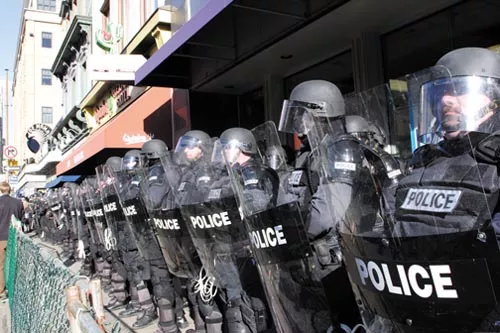
June 2006: Police in riot gear await yet another Oakland protest. - PHOTO BY RENEE ROSENSTEEL
June 2006: Police in riot gear await yet another Oakland protest.

Activists say some of these trends predate 9/11. But the past decade, they say, has seen unprecedented victories for security over free speech.

"What limited democracy exists in the United States has evaporated since 9/11 at an alarming rate," says Naomi Archer, a national activist who joined the protests against the international G-20 summit here in September 2009. Thanks to increasingly heavy-handed restrictions on public demonstrations, she says, "People's space -- for action, for thought, for creative [expression] -- has shrunk. What the state considers an acceptable level of expression has shrunk."

The government has sought to shrink dissent's physical space as well, Archer notes. "Their whole basis for [policing] is to keep a critical mass" from gathering. "Unfortunately, the left hasn't been able to break out of their paradigm to do the things necessary to stop that."

The climate of fear, magnified by the shouts of right-wing television commentators blasting the motives and loyalties of those they disagree with, "reminds me a little of Nazi Germany, where you also had to be fearful of the stranger," says Edith Bell, a veteran local activist with the Women's International League for Peace and Freedom. (Unlike the right-wing talkers who sometimes invoke the Holocaust, Bell was born in Germany and survived several concentration camps.)

"Sometimes it's almost difficult to remember how much things have changed," says Joyce Wagner. On 9/11, she was 17. Since then, she has been to Iraq twice with the Marines -- and is now board co-chair for Iraq Veterans Against the War. "The scariest thing is how many of these things -- just the security culture -- have become usual to people my age."


"When I look at the types of actions taken by the government since 9/11 -- many of which have been challenged in the courts, and the challenges have failed -- I never would have believed it before 2001," says Vic Walczak, legal director for the ACLU of Pennsylvania. "The damage the Supreme Court is doing is not just saying, 'You lose on the [basis of] the law' but, 'You can't challenge the law.' They find some sort of immunity" for the government agency being sued.

For instance, after 9/11 the ACLU was unable to successfully sue the government for detaining people without charges; the government identified detainees instead as "material witnesses" to crimes it never revealed, and courts declined to overturn the designation. 

Walczak cites the case of Abdullah Al-Kidd, a U.S.-born Muslim convert detained in 2003 for 15 months without explanation, whose lawsuit was only recently kicked out of court. Or the case of Egyptian native Abdel Moniem Ali El-Ganayni, who lost his security clearance at the Bettis laboratories here and could not work.

"For the first time in history, [the government] said they couldn't even tell him why they revoked his security clearance" -- a refusal itself attributed to purported security concerns, Walczak says.

Civil libertarians have enjoyed the occasional victory. Walczak cites a lawsuit that got Muslim airline pilot (and Iraq War veteran), Erich Scherfen, and his wife off the no-fly list -- an obvious job-killer for a pilot. Walczak recalls asking Scherfen's wife whether any of her friends were also on the no-fly list. 

Her answer, recalls Walczak: "Yeah, everyone I know."

Everyone she knew from their mosque, that is. "She looks at me and says, 'Don't you have a lot of friends who are on the list and have trouble at airports?'" Walczak recalls. "And I said, 'No, I don't.'"

Saleh Waziruddin, a Canadian Muslim who spent the initial post-9/11 years in Pittsburgh working and joining in protests, still isn't sure why he was detained temporarily at the Canadian border when trying to re-enter the U.S. in 2004, or why he was barred from coming here entirely for five years beginning in 2006. 
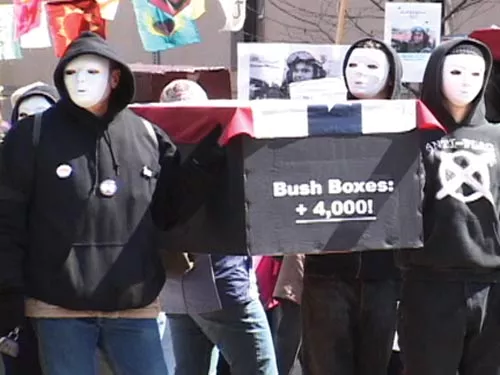
March 2008: The "war on terror" marched on … and so did the protesters. - PHOTO BY CHRIS POTTER
Photo by Chris Potter
March 2008: The "war on terror" marched on … and so did the protesters.

"It could be something as simple as writing a letter to the editor against what the FBI is doing, or participating in a demonstration," he says today. "Somebody put me on a list. I don't even think it is possible to find out why. If there had been an informed reason to deport me, I think they would have asked me [about] specific charges." 

Prior to the start of the Iraq war, in March 2003, there was a degree of cooperation between Pittsburgh's FBI and the local Muslim community. Waziruddin says he attended a meeting between Muslim leaders and local FBI and immigration officials here.

During that meeting, Waziruddin recalls, an FBI representative "said that he was a Marine who fought for the right for free speech in this country." But in the same breath, the agent added "that if someone opposes the war they could be a violent supporter of Saddam Hussein and so should be investigated."


Anti-war activists say that they, too, have failures to answer for. After all, the left has largely failed to stop the government's post-9/11 moves, despite a rise in activism not seen since the Vietnam War.

"The legacy of the anti-war movement is not a good one," says Tim Vining, who headed the Thomas Merton Center from 2001 through 2005. The Garfield-based group was at the center of mass anti-war organizing here, but Vining says its efforts suffered from insularity.

"The leadership of the anti-war movement is dominated by religious pacifists whose message does not at all resonate with the American public" -- especially, he believes, with the African-American and other minority communities who are not widely represented in peace movements here. 

"We have failed to reach the very people the war has most directly impacted -- the working and lower classes," concurs Francine Porter, local coordinator of Codepink Pittsburgh. "We have failed to make the majority of people realize the importance of keeping billions of dollars that could support social programs and much-needed human needs in this country instead of going to war."

Differences over tactics also fractured the anti-war movement, says Alex Bradley, a vocal presence in Pittsburgh for most of the decade with the anarchist Pittsburgh Organizing Group.

The mainstream left, with which POG once cooperated on a limited basis for certain anti-war actions, "couldn't articulate any strategy beyond permitted mass marches and lobbying politicians," says Bradley. "They thought that if the population turned against the war it would end." 

In fact, polling data suggests a majority of Americans began questioning the wars in Iraq and Afghanistan long ago. Yet the wars continued; when Democrats scored huge electoral gains in the 2006 elections, George W. Bush responded by expanding the war effort in Iraq.

Says Bradley, "This lack of understanding of how power operates meant [peace activists] had no idea what to do, once most people agreed with them but nothing was changing." Too often, he says, moderates engaged in "a really problematic retreat" into the "false notions" of patriotism and the seeming respectability of being accepted as legitimate by the mainstream media.

If anything, some activists say, election-year gains may have hurt the cause. "A terrible thing happened to the anti-war movement: Obama was elected," says Porter. "Many on the left helped put him in office. Many were hesitant to go out in the streets and oppose him, even though the war dragged on, and the promises he so eloquently spoke of during his campaign were not kept."

Pete Shell, head of the Merton Center's Anti-War Committee, says that in the end, some in the movement proved to be more anti-Bush than anti-war. But he's not ready to give up.

Shell just returned from a meeting in Chicago, where he spoke to organizers preparing to counter a meeting of the G-8 and NATO there in May. The results of such protests may not be immediate or obvious, he says. "However, I believe that if it weren't for the anti-war movement, the U.S. government may have invaded additional countries in the Middle East after invading Iraq." 

To Mary Sheehan and Gail Austin, at least, the anti-war movement remains viable. Each is a stalwart at weekly street-corner peace vigils held by Pittsburgh North People for Peace and Black Voices for Peace, respectively.

"We try to take a long-term approach," says Sheehan. "We have to get beyond protesting one war after another to try to work to change the mentality to peace being a way of life."

"The wars are still going -- that's what keeps us going," says Austin. "The only other choice is to do nothing. And no change comes from that."

Edith Bell, for one, has no patience for people who sit back while others protest. "What is the anti-war movement?" she asks. "It's volunteers" -- volunteers whose work is often ignored. "We have some hard-core people working and the rest of the people say, 'Oh, it's great what you're doing.' I have no patience for that. Why aren't you in the streets? If we don't get millions of people in the streets, we can't change [anything]." 

And if millions did turn out, she contends, the message wouldn't be ignored anymore. "Right now there have been people at the White House [gates] protesting the pipeline" that, if approved by Obama, would carry oil from Canadian tar sands through the U.S. The protests are motivated by environmental concerns, especially misgivings that exploiting the tar sands would release huge amounts of greenhouse gases certain to worsen global warming. Hundreds have been arrested so far, Bell notes, but the demonstration has been ignored by most news outlets.

Even as she waits to be arrested at the White House fence, national direct-action organizer Lisa Fithian sees the future of activism in local issues. Fithian helped organize here during the G-20 summit in 2009, but recently she has spent much of her time training activists to tackle problems specific to large cities across the country.

"All of those groups are gearing up for a fall of action," she says. "The impact [of wars] is no less [now], but people are dealing with more immediate crises."

Those who are still active against the wars, meanwhile, have changed their tactics. Wagner, of Iraq Veterans Against the War, says her group is organizing near military bases "to stop the redeployment of traumatized troops" with post-traumatic stress disorder or traumatic brain injuries. 

"My hope is that we're not looking at a dead movement," she concludes, "but at a movement that needs to reassess itself."
Thursday, September 1, 2011

Clarity about exploitation (Letter to People's Voice)

Clarity about exploitation

(Letter to People's Voice, Sept. 1-15, 2011)

Clarence Torcoran’s “Who’s exploited, and does it matter?” in the July issue’s Marxist Theory section makes a good point that exploitation is about the relationship to accumulating capital and not the physical working conditions or pay. But his claim that if some workers are exploited and others are not then this would mean capitalism can be reformed misses a major point of Marx’s analysis. While the working class is exploited as a class, only workers who produce surplus value (anything commodified, including services) are exploited in the Marxist sense, and this matters because it shows us both the relationship between, for example, public sector and retail workers with manufacturing and service workers, and also helps us realize the true magnitude of the exploitation of the whole class.

Marx observed in Theories of Surplus Value “What a convenient arrangement it is that makes a factory girl to sweat twelve hours in a factory, so that the factory proprietor, with a part of her unpaid labour, can take into his personal service her sister as maid, her brother as groom and her cousin as soldier or policeman!”

The insight that some workers are exploited and their exploitation pays for the non-commodified services of other workers has nothing to do with one group of workers being more important or needing more reforms, but helps us to understand where the wealth that we produce as a class comes from so that we can take it back from the capitalists. Torcoran said as much in his People’s Voice article “Wages facing downward pressure” five years ago (“Workers at the `point of production’ ... have the power to choke off the generation of profits”).

S. Saleh Waziruddin, Niagara Falls, ON

Wednesday, April 20, 2011

Trying to be heard (2011 federal election St. Catharines debate)

Trying to be heard

BOB TYMCZYSZYN Standard staff
St. Catharines candidates squared off in a debate Tuesday at St. Catharines Collegiate but Christian Heritage Party candidate David Bylsma spoke to a small group outside the auditorium.

Moments before the St. Catharines-Thorold Chamber of Commerce candidates debate was set to begin, David Bylsma stood at the front of the auditorium and shouted for the attention of crowd.


“Can I have your attention please,” Bylsma said. “My name is David Bylsma, and I am a candidate in the federal election in the riding of St. Catharines.”


Bylsma, a veteran of six election campaigns for the Christian Heritage party, was not permitted to take part in the debate. This, he said, was a travesty and an insult to the democratic process. Still, he wanted voters to know who he was and that they could come and speak to him about his platform.


Moments after Bylsma thanked the crowd for their time, another candidate barred from the debate — Communist Party candidate Saleh Waziruddin — also stood up.


Waziruddin said his exclusion from the debate was unfair and robbed voters of a chance to hear all perspectives on the issues.


“By way of applause who wants to be able to hear all viewpoints on the issues of this election?” he said, generating a loud applause from the crowd.


Chamber of Commerce representative Kithio Mwanzia explained that two years ago, the organization decided to change the rules around the debate. Only those candidates whose parties had won at least 2% of the vote in the previous election would be allowed to participate. Neither the Communist or Christian Heritage party reached that threshold in the 2008 election.


Bylsma and Waziruddin were allowed to set up tables outside the auditorium to speak to voters and hand out campaign materials.

Saturday, April 16, 2011

Fringe candidates aren't afraid of long odds (2011 federal election St. Catharines riding)


Fringe candidates aren’t afraid of long odds

Two new candidates running in St. Catharines

The odds are stacked against them. Every election, candidates from small parties run for office with little in the way of resources or name recognition behind them.


But that doesn’t stop them from running or doing what they can to challenge the candidates from the mainline parties.


“I think the really interesting ideas are out here on the fringe,” said David Bylsma, the Christian Heritage Party candidate running in the St. Catharines riding. “The Green Party started on the fringes, and now they are a serious political party. I think our day like that is coming.”


Bylsma is a veteran of six political campaigns for the unabashedly religious political party that claims it is the only party that “recognizes the clause in the preamble of our constitution that recognizes the ‘supremacy of God.’ May He truly have dominion in Canada from sea to sea.”


The 40-year-old St. Annes resident said part of the reason he is running is that the Conservative party isn’t really a conservative party.


“ They’ve really drifted away from being social conservatives,” the father of eight children said. “ But you at least thought they would be fiscal conservatives, but they have abandoned that, too.”


Running on a small government, pro-life and social justice platform, Bylsma is hoping voters who’ve had enough with politics in Ottawa will give his party a chance. He said he understands the CHP has a long shot at best of winning a seat in the House of Commons, but doesn’t think a vote for him is a wasted ballot.


Neither does Saleh Waziruddin, the St. Catharines riding candidate for the Communist Party of Canada “If voting for the Communist party is a waste, then so is voting for any of the losing parties, or even the winning party, because they don’t need your vote,” he said. “ Voting Communist sends the loudest message.”


Although it’s Waziruddin’s first campaign as a candidate, he is not without political experience. He was the campaign manager for 2008 St. Catharines Communist candidate Sam Hammond.


The 33-year-old call centre worker said he is running because he has had to watch too many people lose their jobs, particularly in manufacturing, while corporations get tax breaks and maximize their profits.

“We have to put an end to this reverse-Robin Hood government,” he said.


Waziruddin said he understands small parties like his face long odds, but he sees potential in a coalition of like-minded parties.


“ We could build a coalition of the left, all the parties on the left that could affect change,” he said.

Tuesday, February 1, 2011

‘We’re not certain what will happen next’

 ‘We’re not certain what will happen next’

Protesters shout anti-Mubarak slogans during an anti-government protest in Tahrir square in Cairo on Monday. Egyptian President Hosni Mubarak overhauled his government to try to defuse a popular uprising against his 30-year rule, but angry protesters reje

Sameh Awad has been living in Canada for the past 16 years.


But a bit of his heart remains in Egypt, his homeland.


And it aches for his family and relatives who are living through the civil unre s t threatening the Arab world’s most populous nation.


“ We hope they will be safe,” said Awad, who has two pharmacies, one at Greater Niagara General Hospital. “ We feel sorry for the people, we worry for them. We’re not certain what will happen next.”


Egyptian President Hosni Mubarak ove rhauled his government Monday to try to defuse a popular uprising against his 30-year rule. But angry protesters rejected the changes and said he must surrender power.


On the seventh consecutive day, tens of thousands of protesters rallied in Cairo’s Tahrir Square, chanting, “Get out … We want you out,” and singing Egypt’s national anthem.


Troops backed by tanks made no effort to disperse the crowd. Egypt’s powerful army now appears to hold the key to Mubarak’s fate. Although the generals have held back from crushing the revolt, they have not withdrawn support for him.


The uprising, unprecedented in scale and intensity in the once tightly controlled country, erupted last week when frustration over repression, corruption, poverty and the lack of democracy under Mubarak boiled over.


Awad, a 42-year-old pharmacist and St. Catharines resident, has lived in Canada since 1995. He and his wife have two children.


“ I’m very happy here in Canada. When I see the freedom and democracy here, I think I made the right choice when I immigrated to Canada.”


When he left Egypt, the political turmoil wasn’t as bad as it is today.


“ They want democracy and freedom, a better future for their kids. And right now, they don’t feel there’s a good future, that’s why there’s protesters who want to get rid of the government and the president.


“ I support them for sure, but I don’t like the violent action. I’d like them to do it as peaceful as they can.”


About 140 people have been reported killed in clashes with security forces in scenes that overturned Egypt’s standing as a stable country, promising emerging market and attractive tourist destination.


Mubarak, a close U. S. ally and a stalwart in Western policy towards the Middle East, responded by offering economic reform to address public anger over hardships. He also made some administrative changes, which did little to turn back the groundswell against the 82-year-old ruler.


Meanwhile, human rights activists in Niagara gathered in solidarity Monday evening to support the Egyptian call for the ousting of Mubarak and for free and fair elections in the country.


“ When events are unfolding with the potential to change the course of world history, there is no better time to make your voices heard,” said Bruce Allen, who helped organize a rally on the steps of city hall in St. Catharines.


“ We’re putting our voices together with the voices heard around the world in support of the population of Egypt — the poor, the young students and the intellectuals who are calling for change in their country and for an end to tyranny.”


Demonstrations have taken place around the globe calling for Mubarak to leave Egypt.


Allen, a longtime trade union and social justice activist in Niagara, said there’s a “ very small” Egyptian population in Niagara, which makes it all the more important for other locals to stand up and call for democracy, freedom and prosperity for all.


“ Egyptians only make up a small minority of what’s already a small Islamic community in Niagara,” he said. “ It’s like a minority within a minority.”


Allen said he’s disappointed Canadian and American governments have not “ unequivocally” supported the uprising.


“ They should stop propping up the Mubarak regime.”


Susan Howard-Azzeh, a longtime human-rights activist from St. Catharines and founder of the Niagara Coalition for Peace, said she has close Egyptian friends, some of whom are in Egypt now.


One friend, a doctor and retired professor from Waterloo, has been corresponding with her on Facebook.


“ His hotel is overlooking Liberty Bridge. He had one of the first videos to get out ( showing clashes on the bridge), which were posted on the New York Times website.”


Howard-Azzeh said another close friend has family in Egypt. “ He’s very, very worried.” She said while media reports suggest more than 100 people have been killed during the uprising so far, people within the popular resistance believe the figure is much higher.


“ Our friend, who has family in Egypt, believes the dead is closer to 2,000. In his small neighbourhood alone, there was seven dead and that was a couple days ago.


“ Egyptian people are very brave to conduct a popular uprising within a very oppressive regime, which is putting them at great personal danger,” she said.


“It’s just unfortunate that the U.S., Canada and the U.K. are … walking this political tightrope, afraid to say the wrong thing.”


Niagara Falls resident Saleh Waziruddin said if the populist movement in Egypt is successful, it could have positive repercussions for other nations facing similar situations.


Waziruddin, a 33-year-old Muslim, was born in Canada to South Asian parents. He grew up in Saudi Arabia and went to high school with Egyptian friends who are involved in protests outside of Egypt, such as in London, England.


“ I support the people rising up and challenging the system there that only represents the interests of the U.S. and not the interests of Egypt,” he said.


“A change of government in Egypt could change the whole world.”


Dr. Mohamed Elhadidi, a visiting international scholar from Egypt at Brock University, said he expected a revolution to happen, but not so quickly or at this time. He said via e-mail that freedom of expression is talked about in Egypt, but there was no ability for the masses to do anything because of a fear of the repressive security measures at every attempt to rally.


He said new social media had an impact on the mobilization of young people, stunning the opposition.


“ Every day in this crisis means more of the losses in lives and money, but it also reflects the intransigence of the existing regime and dictatorship,” he said. “We pray to God to go through this crisis peacefully and to protect the souls, and live with people in Egypt in the peace and security.”

Sunday, January 16, 2011

Behind Imperialism's Gang-up on the Ivory Coast (People's Voice)

BEHIND IMPERIALISM'S GANG-UP ON THE IVORY COAST
By Asad Ali

            According to the capitalist press, Ivory Coast President Laurent Gbago is a dictator who lost the election to Alassane Ouattara, and the AU (African Union), ECOWAS (Economic Community OfWest African States) and the rest of the world should force Gbago to step down. Except that the election results were declared for Gbago by the country's Constitutional Court, which is the deciding body, not the purely administrative Independent Electoral Commission.

            France and the United States, among other imperialist countries, want us to ignore the Ivory Coast's constitution and pick and choose the winner they like. The writer Leo Gnawa in his article "Ivory Coast: Obama is Wrong" finds a parallel with the Bush vs Gore US election of 2000, which was also decided by a court and not administrators. Would Americans have accepted NATO or UN troops intervening for Gore?

            Ouattara is a former IMF (International Monetary Fund) Deputy Director who was Prime Minister under President Felix Houphouet-Boigny. Gbago was a leading dissident and political prisoner against Houphouet‑Boigny, later founding the FPI (Ivorian Popular Front). Houphouet‑Boigny favoured French businesses and helped overthrow his neighbour Kwame Nkrumah, winner of the Lenin Peace Prize and independence hero of Ghana, the first non‑Arab African country to be decolonized.

            Before the Ivory Coast's independence from France, Houphouet-Boigny was a French MP leading other African MPs in alliance with the PCF (French Communist Party). He broke with the communists under pressure from socialist Francois Mitterrand (later French President) saying "I, a bourgeois landowner, I would preach the class struggle?". In 1985 Ivory Coast was the first non‑Arab African country to restore ties with Israel.

            In 2002 Gbago survived a coup attempt followed by a civil war, when France intervened with troops to get concessions for the rebels while recognizing Gbago's right to be President. Some commentators fear that if Ouattara is allowed to seize power from Gbago he will again favour the IMF and French businesses, whereas Gbago would require competitive bidding in the Ivory Coast'sfavour, giving equal opportunity to Chinese and Russian investors.  If the AU and ECOWAS intervene in the Ivory Coast on behalf of France and imperialism, it could be a dangerous example threatening the sovereignty of other African countries under international pressure such as Zimbabwe or Sudan

            Ouattara called for ECOWAS special forces to invade, predicting Gbago "will start running away. I know him well." The Communist Party of neighbouring Benin issued a statement rejecting any intervention "whatever the excuse" and that it was "inadmissible for any patriot and a democrat" to call for the trampling of Ivorian sovereignty.  Meanwhile Gbago has stood firm in the face of a visit by Nigerian ex‑President Obasanjo, who an unnamed Ouattara advisor has said was going to give an ultimatum "in a mean way."

            The Ivory Coast was also abandoned by its US lobbyist and ex-Clinton aide Lanny Davis, on the grounds that Gbago would not take Barack Obama's phone calls so that he could be "presented with options."

(The above article is from the Jan. 16-31, 2011, issue of People's VoiceCanada's leading communist newspaper. Articles can be reprinted free if the source is credited. Subscription rates in Canada: $30/year, or $15 low income rate; for U.S. readers - $45 US per year; other overseas readers - $45 US or $50 CDN per year. Send to People's Voice, c/o PV Business Manager, 706 Clark Drive, Vancouver,BCV5L 3J1.)