Surprise Attack! Revolution carried through by small conscious minorities

Surprise Attack! Revolution carried through by small conscious minorities
Kabul in the Republican Revolution of 1973

Tuesday, October 27, 2020

Haldimand mayor feels undermined by St. Catharines “leftist agenda” (The Niagara Independent)

(https://niagaraindependent.ca/haldimand-mayor-feels-undermined-by-st-catharines-leftist-agenda/)

Haldimand mayor feels undermined by St. Catharines “leftist agenda”

protestors at a housing development set tires on fire.

Protestors in Caledonia set tires on fire in protest of a housing development.

Renaissance polymath Leonardo de Vinci once aphorized “the greatest deception men suffer is from their own opinions.”

Let’s give the benefit of the doubt to the City of St. Catharines’ Anti-Racism Advisory Committee, and City Council. Perhaps their motive was simply to be instructively helpful to the citizens of Haldimand County, suggesting the fashion in which the Indigenous blockades at an urban development construction site in Caledonia should be handled. Communication, not confrontation. Talk, not tasers.

Mayor Walter Sendzik and his Council have talked a lot about support for First Nations. In fact, they have a Memorandum of Understanding (MoE) with the Niagara Native Centre, and commence every council meeting with a statement acknowledging the land occupied by the City is the traditional territory of the Haudenosaunee (Iroquois, or Six Nations) and Anishinaabe (Ojibway and Mississauga) tribes, and that our “standard of living is directly related to the resources and friendship of Indigenous peoples.”

At the opening of the Oct. 19 video-conferenced council meeting, Sendzik put his cards on the table, stating that “it’s important for communities like St. Catharines to articulate the importance of working with our Indigenous brothers and sisters, and getting to a place of better understanding, whether it be out on the East Coast as it relates to the lobster fishery, or in Caledonia. The use of force, and the use of violence and aggression, is never a good tool towards reconciliation.”

What came next was a recommendation put forward by the City’s Anti-Racism Advisory Committee, which was presented by Coucillor Greg Miller and endorsed unanimously by Council. The resolution was sent to the Haldimand County mayor and council, Haldimand Police Services Board, and Premier Doug Ford, urging that “police not be used to escalate the conflict, and instead use nation-to-nation negotiations and meaningful consultations to settle all claims.”

Haldimand mayor Ken Hewitt responded with an email to Sendzik, in which he said he felt undermined by the “offside” and “leftist” resolution, which “assumes that racism is driving the efforts by (me) and Council, the police, and the courts”… as they “attempt to resolve the illegal occupation” by the protestors.

Such are the pitfalls of dispensing unsolicited advice.

Saleh Waziruddin, Chair of the Anti-Racism Advisory Committee, asserted that the reason the Haldimand Police Services Board was included in the resolution was because a communiqué from the Board referred to the Caledonia protesters as “terrorists.” Waziruddin considered that rhetoric to represent a “dangerous escalation”, and referenced the Ipperwash Crisis 25 years ago in which native protestor Dudley George was killed by an OPP officer.

“There are residents in St. Catharines, and people who work in the City, who are at Caledonia out of solidarity with the protestors, and they could be vulnerable to police violence,” said Waiziruddin as a further explanation of his committee’s interest in the Caledonia dispute. He also noted that a St.Catharines-based Indigenous journalist, Karl Dockstader, had been arrested at the site. “Haldimand is right next door, and it would be wrong for St. Catharines to do nothing,” insisted Waziruddin.

Asked if he felt that the blockades in Caledonia, and similar Indigenous actions earlier this year such as the rolling blockades on Highway 401 near London and Kingston, and on the Via Rail tracks near Belleville, should be allowed to proceed unencumbered, Waziruddin responded, “It’s not in our committee’s mandate to take a position like that. But many people in Hamilton support the (Caledonia) protesters, despite the inconvenience of the blockades.”

Sendzik’s response to Hewitt (a three-term mayor in Haldimand County) via email acknowledged that “the motion would have been better if discussed within a time frame that would have permitted more understanding of the situation.” He insisted that the spirit of the motion was pure, and not tied to a leftist agenda.

When asked for comment, Mayor Sendzik’s office referred The Niagara Independent to Councillor Greg Miller who brought the motion to council. Miller did not respond to multiple requests for an interview.

Hewitt suggested that the more appropriate and respectful action for St. Catharines Council would have been to defer a vote on the motion until he and Sendzik could have had a conversation. He questioned whether, if First Nations protestors had taken over Montebello Park, local government would have been so tolerant.

With regard to the arrest of Karl Dockstader, Hewitt commented “this individual is playing a bit of a game with the public at large by saying that he was there reporting. He was actually there playing lacrosse, participating in activities with protestors on site. If you’re a reporter, if you’re there performing a function, that’s fair.  But if you’re involved beyond your duties, then you should be charged just the same as anyone else. Did it ever occur to ask why no other journalist that’s been at that site has been arrested?”

Hewitt believes that the mainstream media continues to portray the people at the blockades as peaceful protesters. “I’m not afraid to say what’s really going on, and what’s going on here is a lot less than peaceful. Through experience, they know how far to push. At what point do we take a measured approach? At what point do laws apply?,” said Hewitt.

“To those who believe that we’ve stolen this land (from Indigenous peoples), that all of this land is theirs, that we’re all squatters, I say ‘you lead the charge’…. show me that you really mean that and go over to Six Nations and say ‘here’s the title of my property, because I stole it from you’. Yeah, well….you know it’s not going to happen.”

Ontario Superior Judge R. John Harper ruled last Thursday to ban all barricades in Haldimand County, and limit access to the housing development in question. Clashes between barricade defenders and the OPP occurred several hours later, as the police moved to enforce the court injunction. Protestors accused the OPP of using rubber bullets and tasers, while the police responded that several cruisers were heavily damaged as the protest grew more violent, and the police used “appropriate, non-lethal force in response.”

Foxgate paid $4 million to purchase the property in 2016 from private owners. The land has been in private ownership since 1853. The claim being advanced by the protesters at Caledonia is that prior to 1853, the Crown should not have allowed the land to come under private ownership.

The deal to purchase the land was signed by Foxgate with the elected council of Six Nations. The protestors are claiming that there was not enough community consultation and that the Six Nations elected council doesn’t have a legitimate mandate to speak for Six Nations band members.

Foxgate gave $352,000 in cash and transferred 42 acres of land to Six Nations as part of an accommodation agreement.



Thursday, October 22, 2020

Haldimand mayor accuses St. Catharines city council of ‘leftist agenda’ in Indigenous land dispute (St. Catharines Standard)

(https://www.stcatharinesstandard.ca/news/niagara-region/2020/10/22/haldimand-mayor-accuses-st-catharines-city-council-of-leftist-agenda-in-indigenous-land-dispute.html)

Haldimand mayor accuses St. Catharines city council of ‘leftist agenda’ in Indigenous land dispute

Motion to support negotiations over police action called ‘plain and simple wrong’

Haldimand County Mayor Ken Hewitt is seen at a mayor’s charity gala in 2016.

The mayor of Haldimand County is accusing St. Catharines city council of jumping on “a leftist agenda” that is “more damaging than helpful” after councillors asked that police not be used to escalate conflict in an Indigenous land dispute in that community.

St. Catharines council unanimously passed a motion Monday night on the recommendation of its anti-racism advisory committee, asking officials in Niagara’s neighbouring community to continue to negotiate rather than call in police at 1492 Land Back Lane.

“My frustrations are with your motion that undermines a situation that directly affects us here in Haldimand,” Mayor Ken Hewitt wrote in an email to St. Catharines Mayor Walter Sendzik Wednesday night.

“Too (sic) simply jump on a leftist agenda and assume that racism is what is driving mine, the OPP, and our courts as we attempt to resolve this illegal occupation of validly owned land by Losani is plain and simple wrong.”

But Sendzik defended the council motion in an email back to Hewitt, obtained by the One Dish, One Mic CKTB radio program and posted on Twitter.

“This isn’t a leftist agenda,” Sendzik wrote. “The action in the motion states that police force not be used to escalate the conflict and to focus on nation to nation negotiations to settle the land claims. That was the spirit of the motion and one that we should all should (sic) support.”

The issue involves property south of Caledonia that was slated for a residential development and has been occupied by Indigenous land defenders since July.

The city’s anti-racism advisory committee passed a resolution on Oct. 7 recommending St. Catharines council send a message to the Ontario and Haldimand County governments and the Haldimand County Police Services Board asking that police not be used to escalate the conflict and that meaningful consultations be used to settle all claims.

Merritton Coun. Greg Miller, who moved the motion Monday night, said Thursday that at the end of the day council was suggesting that instead of having police action there continue to be a nation to nation negotiation and discussion.

“Emotions are pretty high around this issue, but I feel pretty safe saying an email like that from Ken Hewitt doesn’t help,” Miller said.

“What we wanted to see, and I think what our anti-racism committee wanted to see, is to take some of the emotion out and have a discussion and equitable negotiation and, unfortunately, when you refer to the occupation as illegal, that’s just stoking the flames and I think that’s really unfortunate.”

Hewitt wrote in his email to Sendzik, which he asked to be shared with the rest of council, that the St. Catharines motion “does not serve the 200 or so innocent home buyers who are patiently waiting for their dream home to be built.”

Hewitt added that contractors are waiting to earn the incomes they deserve and the community wants to see the “constant sources of intimidation and threats of violence” come to an end.

“You see what you may hear or read about on mainstream or social media is not fully capturing what is happening here on the ground,” Hewitt wrote.

“Before I would support a motion that directly affects another community in the Province I would take the time (to) gainfully appreciate all sides of the equation prior to succumbing to some one sided agenda that is more damaging than helpful.”

Sendzik responded in his letter that members of St. Catharines council and the community have become more interested in the land dispute with the arrest by the OPP of a local journalist, referring to Karl Dockstader of One Dish, One Mic who was charged after reporting from the camp.

Sendzik added that the city has a memorandum of understanding with the Niagara Native Centre and it is a cornerstone of how the city is walking down the path of Truth and Reconciliation.

“Two members of the leadership at the NNC have been arrested by the OPP related to land dispute (one being the journalist) and in the context of what is happening in Canada recently (and its troubled past with First Nations, Metis and Inuit) it is clear that WE — the collective we — have a long way to go towards both understanding and building new ways to address issues that have been framed for generations against First Nations.”

Karena Walter is a St. Catharines-based reporter, primarily covering city hall for the Standard. Reach her via email: karena.walter@niagaradailies.com


Tuesday, October 20, 2020

St. Catharines council supports negotiations over police action at 1492 Land Back Lane (St. Catharines Standard)

(https://www.stcatharinesstandard.ca/news/council/2020/10/19/st-catharines-council-supports-negotiations-over-police-action-at-1492-land-back-lane.html) 

City weighs into neighbouring county’s Indigenous land dispute

1492 Land Back Lane in Caledonia on MacKenzie Road.

St. Catharines city council is asking that police not be used to escalate the conflict at 1492 Land Back Lane, south of Caledonia, at the recommendation of its anti-racism advisory committee.

The parcel of land slated for a residential development in Niagara’s neighbour, Haldimand County, has been occupied by Indigenous land defenders since July.

The anti-racism committee passed a resolution Oct. 7 recommending St. Catharines council send a message to its government neighbours asking them to choose negotiations with land defenders over police action.

“What I’m asking us to do is support our anti-racism advisory committee who feel it’s important for the city to show leadership and support of the Indigenous community and First Nations communities, not just in St. Catharines but throughout Ontario and throughout Canada,” said Merritton Coun. Greg Miller, who brought the motion to send a message forward before council Monday night.

Councillors waived the notice of motion requirement so they could deal with the anti-racism committee’s recommendation immediately.

Miller said the issue is complex but there was an urgency because the committee felt council should weigh in on the matter before an Oct. 22 injunction hearing, at which time it’s believed Ontario Provincial Police may move in to remove people occupying the site.

Council unanimously voted to support sending a message to the Ontario and Haldimand County governments and the Haldimand County police services board requesting police not be used to escalate the conflict and instead, use nation-to-nation negotiations and meaningful consultations to settle all claims.

Saleh Waziruddin, chair of the anti-racism committee, told members during the Oct. 7 meeting there is an escalating situation in a neighbouring community where the mayor, council and police services board have advocated police action.

He noted that can be a dangerous escalation when looking at history and the Ipperwash crisis, during which Indigenous protester Dudley George was shot and killed by police 25 years ago.

Waziruddin said there is a local connection to Land Back Lane with the arrest of Indigenous journalist Karl Dockstader, who was covering the land dispute.

But he said it goes beyond that.

“It’s not just about the St. Catharines connection — the mayor has already made a statement in support of that journalist — but it’s also about St. Catharines’ role as a municipality with a dangerous situation next door and not doing anything about it,” Waziruddin said.

Dockstader, co-host of One Dish, One Mic on St. Catharines CKTB 610AM, was charged with criminal mischief in September after reporting from a camp at the land dispute. The arrest was strongly condemned by the Canadian Association of Journalists and Canadian Journalists for Free Expression.

While the motion had the full support of all councillors, a couple questioned whether the anti-racism committee was overstepping its mandate by dealing with issues taking place outside of the city and region.

City clerk Bonnie Nistico-Dunk said that was a question she would be looking at when she does a review of council committees and meets with their chairs.

The anti-racism committee also recommended city council request Niagara Region council and the Niagara Regional Police services board support the recommendation. That was struck from the motion Monday night because those bodies are not meeting before Oct. 22.

Karena Walter is a St. Catharines-based reporter, primarily covering cityhHall for the Standard. Reach her via email: karena.walter@niagaradailies.com


Thursday, September 3, 2020

Anti-racism advocates remain hopeful for change in Niagara (Niagara This Week and St. Catharines Standard)

(https://www.niagarathisweek.com/news-story/10160547-the-long-road-to-reform/ alternate version https://www.stcatharinesstandard.ca/news/niagara-region/2020/09/03/anti-racism-advocates-remain-hopeful-for-change-in-niagara.html)

Anti-racism advocates remain hopeful for change in Niagara

Much work remains to be done to end racism in Niagara, activists say


The tone was one of exasperation.

As members of the grassroots group Matter of Black met last week the topic quickly went to Jacob Blake, a Black man who was shot in the back by police in Kenosha, Wisc. To them, it was just another example of systemic racism.

It was also a reminder of how much work anti-racist advocates have in front of them. Not only in the U.S., but here in Niagara, where local efforts have been met with varying degrees of success.

“We’re seeing the very basic first steps. Change doesn’t happen overnight,” said Erica Williams, a Matter of Black member.

The group was formed to reinvigorate the regional Emancipation Day event, and works alongside BlackOwned905, which shines a light on businesses owned by Black people in Niagara.

Garden City politicians recently dealt with a motion that came through the city’s anti-racism committee that recommended 10 changes for Niagara Regional Police.

It passed after three recommendations were removed: body cams for police officers, police demilitarization and ending street checks. It was then included as correspondence to Niagara Region and the police services board in a separate motion brought to regional council by St. Catharines Mayor Walter Sendzik. That motion called for a series of reports from the NRP and was passed, though anti-racism advocate Saleh Waziruddin said much of the information was already published.

Waziruddin, a member of the St. Catharines anti-racism committee as well as the Niagara Region Anti-Racism Association, said he was frustrated with what he felt was politicians ignoring the comments of the Black, Indigenous and people of colour (BIPOC).

“Definitely there was a lot of resistance and just a lot of lack of listening,” he said.

An Indigenous man from Welland talked about being brutalized and racially insulted by police, but Waziruddin said he felt the man’s presentation was largely ignored by regional politicians who instead focused on the low number of complaints lodged against NRP officers. But with many people in the communities affected already distrustful of police, he said they’re not likely to come forward with complaints.

The Niagara anti-racism group is now setting its sights on the police services board, where Waziruddin said real change can happen. Members are planning a letter-writing campaign to convince board members to make changes.

“There’s a lot of activity going on still,” Waziruddin said. “There’s still a big opportunity for reform here in Niagara.”

Tamari Kitossa, associate professor of sociology at Brock University, cautioned that social movements take time, energy and money. In order for them to be successful, he said activists much continually recruit members who can bring fresh ideas and energy.

He also said advocates must learn from the past.

“They must, in fact, read history,” Kitossa said, adding that learning what worked and what didn’t work previously, can go a long way for current-day activists.

He also said supposed successes don’t always turn out that way. Kitossa used the work of Dudley Laws and the Black Action Defence Committee. The group formed in response to police shootings of Black men in Toronto and its work led to the creation of the Ontario Special Investigations Unit, which was supposed to provide more accountability.

Kitossa said the SIU has basically become “police investigating police.”

Though he’s cautious about this current movement’s ability to force real and lasting change, Kitossa said the local level is key, where activists can more easily access politicians and plead their case.

Siscoe doesn’t think the current movement is going to run out of steam before change is achieved.

“This is a bus that started rolling downhill and it’s not going to stop,” he said.

Waziruddin said the Niagara anti-racism group has formed partnerships with other groups including NEXTNiagara, the performing arts centre and Niagara Folk Arts Multicultural Centre.

Williams said members must not focus solely on policing reforms, and that racism exists in all institutions.

Siscoe agreed. He said he’s committed himself in recent years to reading about the experiences of BIPOC, both in Canada and the U.S., and drew parallels between the experience of Black Americans and Indigenous people in Canada.

“We need to start making sure all public institutions reflect the community they serve,” he said.

The movement, he argued, requires buy-in from everyone.

“It’s not good enough to be not a racist, we have to be an anti-racist.”

Williams said the work starts in people’s inner circles.

“It’s that co-worker you know is being harassed but you say nothing,” she said.

Story Behind the Story – Months after the death of George Floyd spurred anti-racism protests around the world, reporter Luke Edwards checked in with local activists to see how their efforts are going, and how they keep the momentum up.

Clarification – Sept. 3, 2020: This story was updated to clarify the separate motions brought to St. Catharines and regional council.

Friday, August 14, 2020

St. Catharines Council calls for “De-Funding” of local police (The Niagara Independent)

(https://niagaraindependent.ca/st-catharines-council-calls-for-de-funding-of-local-police/)

St. Catharines Council calls for “De-Funding” of local police

nrps police cruiser

Earlier this week St. Catharines City Council opted to call on the Niagara Region and the Police Services Board – the civilian body that oversees the Niagara Regional Police – to “re-assess ‘adequate policing” requirements.

This motion was on the heels of a motion the city passed earlier this month calling for the decriminalization of personal possession of illicit drugs.

The call specifically asks for the NRPS and Board to “re-assess ‘adequate policing’ requirements based on removing welfare checks, mental health, and suicide threat calls, as well as foot patrols that are only demanded because of perception.”  It also asks the Niagara Region to re-allocate the savings to a civilian service such as the EMS, Niagara’s ambulatory service.

The composition of the seven person Police Services Board is determined by the Niagara Region, which appoints four of the positions with the remaining three appointed by the Government of Ontario.  The Niagara Region is the primary source of funds for Niagara’s police service.

Council’s decision represents an about face for the City of St. Catharines and particularly, Mayor Walter Sendzik and its preferred level of policing in St. Catharines.  In October 2018, the previous Council including Sendzik – who was an outspoken proponent – had called for an increased police presence in the downtown area, including foot patrols.

Other initiatives that Council also opted to support included the establishment of a “purely civilian” oversight body that bars former police officers from participating; the release of race and hate-crime related data; requiring officers to intervene in instances of excessive use of force; require the consideration of an officer’s use of force during their performance reviews; the publishing of race and hate-crime related data, and increased training for officers in the areas of diversity, mental health and anti-racism.

Council narrowly gave the thumbs down to several additional proposals before them.  Ending street checks, commonly known as ‘carding’ and the recommendation for the police service to sell its armored rescue vehicle and ban the use of tear gas or other agents against protesters were both lost on a tie. Local politicians and activists continue to refer to the rescue vehicle as an “armoured tank” a point the Chief was quick to correct. “It’s not a weaponized piece of equipment,” explained the Chief. “It is a mobile piece of safety equipment that I feel I am obligated to provide to our members.” He explained that the rescue vehicle is used in very high-risk scenarios to not only protect officers but members of the public who are in grave danger.

The vote on recommending the use of body cameras by police officers was also defeated by one vote.

“Racism is not, and will not be tolerated within the Niagara Regional Police Service,” Niagara Regional Police Chief Bryan MacCulloch told Council at the beginning of the debate.  “I can assure you that that is in keeping of the values and the integrity of our members both sworn and civilian.”

When asked by Councillor Kevin Townsend whether the police force was “bombarded with complaints from civilians,” MacCulloch answered in the negative.  He noted the service receives about 100 public complaints per year with a “large number” of the complaints being deemed vexatious by the Office of the Independent Review Director, the provincial body that oversees and manages all police complaints in Ontario.

Councillor Greg Miller’s comments included reference to a growing police budget over the past several decades.  MacCulloch responded by noting the force has increased by 176 members since 2000 to deal with the increased demand, complexity, population and expectations that are being placed on police services through legislation.  He also noted the financial impacts of the collective bargaining and arbitration processes.

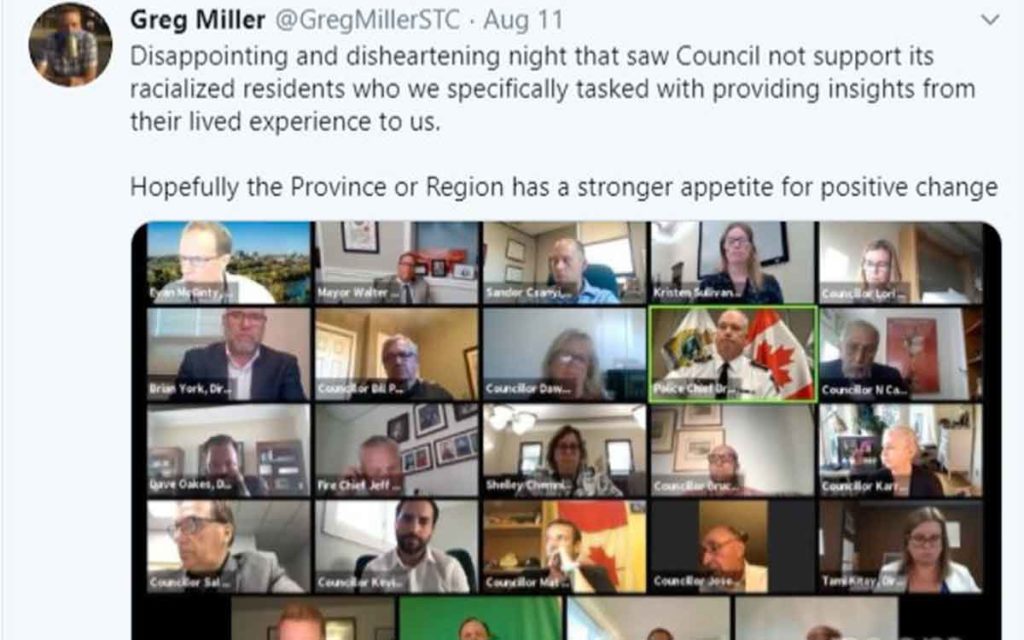
greg miller tweet

Miller took to Twitter following the meeting to voice his displeasure with some of his council colleagues, saying in part, “Hopefully the Province or Region has a stronger appetite for positive change.”

The recommendations originated at the City’s anti-racism advisory committee.  The committee consists of 10 individuals and is led by Chair Saleh Waziruddin.

Waziruddin has previously run as a candidate for the Communist Party of Canada.