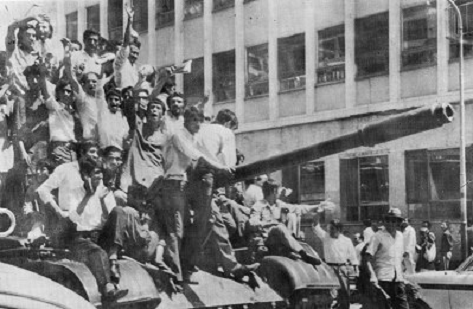
Surprise Attack! Revolution carried through by small conscious minorities
Kabul in the Republican Revolution of 1973
Sunday, January 16, 2011
Behind Imperialism's Gang-up on the Ivory Coast (People's Voice)
Thursday, September 23, 2010
Submissions to YCL-LJC Convention Discussion Bulletin Contribution
1. Democracy vs. Bureaucracy: Cutting Red Tape or Taping Up Reds?
I think some of us have “democracy” and “bureaucracy” completely mixed-up. More than one YCL leader has referred to additional procedures, meetings for making decisions, and committees as being “bureaucratic”, but nothing could be further from the truth. This concept of bureaucracy is the bourgeois concept expressed by the sociologist Max Weber, who said bureaucrats are full-timers who just try to expand their functions. In a progressive organization functionaries (staff) do work decided on by the membership, this is not the “bureaucracy” those who have mixed up democracy for bureaucracy are talking about though.
Maximizing collective discussion, the opportunity for members to say “wait a minute! You're about to make a big mistake!”, and having someone designated as accountable and responsible (e.g. a chair) is NOT bureaucratic but democratic. The democratic part of democratic centralism means the maximum discussion, this is the only legitimate basis for any decisions that we are centrally holding anyone accountable to.
On the other hand I have seen a real danger of bureaucracy, but this is the exact opposite of having more meetings, chairs, or procedures. I have seen instances where meetings aren't held collectively but instead are one-on-one's with follow-ups in a group, or decisions are made beforehand by higher bodies before a lower body has exhausted discussion, or where in the name of saving time or getting things done decisions and even presentations are handed down from higher up and as a consequence those lower down don't develop, don't make their own mistakes and don't grow. I was even in one provincial meeting where comrades were looking to the centre for action on a provincial matter, and I had to ask myself: are these Marxist-Leninists or Marxist-Mannequins? I would much prefer we messed thing up but learned from it, then doing something perfectly but only be going through motions or mouthing words already scripted for us.
Pop quiz: what's the difference between a puppet and a mannequin? A puppet at least moves when you pull the strings.
To loosely quote Fidel Castro from a speech to Havana University students on March 13, 1962, “In a yoke. And that is not a revolution! What becomes of the revolution? A school for pets. And that's not revolution! What has to be the revolution? The revolution has to be a school of revolutionaries ... must lead people to study, to think, to analyze, to take deep conviction, so deep that there is no need for those (bureaucratic) tricks... We believe in revolutionary ideas, because we know that our people is revolutionary and we know that our people will be increasingly revolutionary because we believe in Marxism-Leninism, because we believe that Marxism-Leninism is an undeniable truth.” To paraphrase Maurice Thorez, leader of the French CP, from his 1931 newspaper articles, “No mannequins in the YCL!”. We should push for more taking-of-ownership by YCL bodies and members even if at first there are growing pains as we learn and struggle.
--
2. Odds about our ends: Can the YCL influence the labour movement, “is” our members learning, leadership communication, and “bigging up” ourselves
Four short thoughts that aren't enough to make a separate contribution by themselves:
1. Labour: I have heard from some YCL leaders that that the labour movement's problems should be solved within the labour movement, but I think we as the YCL have a role even if many of us are outside of organized labour.
There is a premium in having not just youth attendance but also a youth perspective, which young communists can give the best. When we show up at strike pickets and labour movement events, with one exception I know of, we are welcome and make an impact in people's minds. Communism is not just for old fogies, many sensible youth are young communists and we're here to stay. Our presence as the YCL and our fight for more militancy will give courage to the pro-struggle anti-collaboration forces within organized labour. It should be a standing club agenda item to organize picket support and build relationships with workplaces.
2. Education: Many members are impressed with classes at YCL schools, but I don't think we are being effective with actually changing and developing ideas. We need to set the context for our classes in the political life our club members have confronted, and explicitly show how what is taught should change our way of thinking about the political fights we are involved in. It is so rare that youth in general get to have an organized political discussion that people are happy just to be able to express their opinion, but we need to do more in our classes to actually change each others' opinions.
3. Leadership: As a CC and provincial executive member I am foremost guilty of this: executives and committees need to always send their minutes or a summary of meetings down to the club level. Each member should be clued in on what the provincial and central leadership is working on. These document can tend to become public so even something short like what was discussed and decided should be routinely e-mailed out.
4. Member development: Capitalism develops unevenly and our members have uneven development, some are much more experienced and developed than others. This can be intimidating for those who are in a political discussion with someone who is quicker with facts and ideas. But it would be a mistake to make a “little kids table” to accommodate people who feel uncomfortable, we want to bring newer people in deeper and so they should hold their heads high and take their rightful place at the “big kids table”. Yes it's intimidating, but if you can't take on your fellow YCLer in a political discussion what chance do you stand in taking on capitalism, or the boss at work? We need to “big up” ourselves and get right in there with the people who can quote Lenin and Marx at the drop of our hat, quote from your own life experience or even Big Bird if that's where your politics are coming from for now. We need more new people, but we also need them to develop rapidly and bloom with a bang.
Friday, September 17, 2010
Against Cinderella Memberships, Yes We Can Have Blood-Soaked Steaks On Every Plate (not that we should), and Other Comments on Bulletin #2 (YCL-LJC Convention Discussion Contribution)
I think that the convention contributions about Constitutional Amendments and By-Laws and also about Vegetarianism in Bulletin #2, and Third Worldism more recently, are exactly the kinds of contributions we need before the YCL Convention and exactly the kind of issues we need to hash out a the Convention. These contributions are a sign that we have a healthy organization with people who can use their brains to think for themselves, that we’re not just a collection of pets and mannequins who are (barely) warm bodies for other people’s words and ideas.
Of course, that does not mean I agree with what these contributions say, and I hope to address some of the Constitutional Amendments and By-Laws from the Trail Club as well as the article on Vegetarianism here.
I am against the age-ceiling to YCL membership in the proposal (by-law 4 Ageing Out) from Trail. I think this is a reckless change, to say that you should not be a YCL member when you hit 30, because it automatically removes membership without looking at the need for a careful transition to younger members. Leaving the YCL should not be something determined by a clock, but is a political task that isn’t always conveniently managed like a calendar. It takes figuring out to see who to transition the tasks and roles to. Also a 29-year old YCLer might be in the middle of finishing a responsibility or task close to their 30th birthday, it would be arbitrary to say they cannot finish their job because of their birthday.
Having an automatic cut-off for membership when the clock strikes midnight on your 30th birthday would also create 2 tiers of membership, those who are eligible for election as leaders because of how far they are from being 30 and those who are not. This is undemocratic, YCL members should be allowed to elect ANY member regardless of their age to leadership positions.
The age-limit is a mechanical proposal. I confess, I am 32 years old and would not have been eligible to be elected to the Central Committee if this rule was in place then. But my reasons against it are that it handles the question of transition without regard for the consequences of people leaving the YCL when the clock strikes 12 on their 30th birthday and also is undemocratic because it creates two classes of members. I have worked out a transition out of the YCL in a way where I can take proper responsibility for my work up to the convention, something that depends on more than the Earth’s revolution around the sun.
Amendment 7 asks for National and Provincial Committees to meet at least monthly. I think this is impractical, executives might meet monthly at best. Full committees, which are larger and not executive bodies, would probably need to meet less frequently if they are not just going to be an executive.
I am in favor of gendered speaking lists and use them sometimes where there is a big gender imbalance, but I think it would be wrong to make that a bylaw as for parliamentary meetings like a Convention we need a more simple straight-forward democratic mechanism of every member or speaker having the same rights, even if the composition of the meeting is imbalanced. In a non-parliamentary meeting it’s worth promoting voices that are not often heard, but where top policy decisions are being made we should use parliamentary procedure that is designed to give elected representatives equal voice like in Roberts Rules of Order.
I like the idea of a pro- and con- speakers list, but what about those who are not pro or con?
By-law 6, requiring a uniform and pins, is too much like a paramilitary organization or the boy scouts or girl guides, which is not what the YCL is. We are not an organization of youth with para-military aspirations of uniformity, but have an uneven mix of people struggling against capitalism from different levels of development. Uniforms and pins, especially those differentiating Communist Party members from non-Communist Party members which should be irrelevant as the YCL is independent of the CPC, are the wrong kind of discipline.
Lastly, I call for rejecting the idea that our personal consumption should be restricted. Our personal consumption is not the main danger to the world, the capitalist rule of the world is. While meat eating is certainly less efficient than vegetarian lifestyles, the fact is that we can actually produce enough beef for the whole world under the current system. I calculated that if you took the highest per-capita beef consumption (from Argentina) and calculated how many cows would be required, based on the highest carcass yield statistics by country (so pick a Japanese beef cow), assuming a cow is slaughtered at age two, and from that figured out how much grassland would be needed for 2.5 acres per cow (the low end of the range for organic farming), current grazing lands can cover this amount of cows. Under the current level of agricultural technology we actually can have steak for dinner for everyone every day, but we don’t not because the Earth can’t support it but because production is for profit and not need.
Under socialism we might decide not to have steak every day because we might want to use the resources for something else, but if we decide to have steak every day for everyone we can. The idea that we should restrict our consumption under socialism because of valuing restricted consumption itself, instead of some rational trade-off with an alternative uses of resources, is a defeatist revision of Marxism-Leninism championed by people like Hans Heinz Holz of the German CP who claim the USSR should not have tried to out-produce capitalism but should have tried to pursue alternative non-consumptive ethics. Marxism-Leninism says socialism can outproduce capitalism in terms of making things we need because socialism transitions us to where we can eliminate scarcity and produce for needs and not profit, the way forward is to be able to provide steaks for everyone who wants one rather than saying we should all be vegetarians. Of course, this doesn’t mean we should not be vegetarians for other reasons, just that production capacity under socialism should not be one of them.
Wednesday, September 1, 2010
Third World-ism is Not a Challenge but Rather is “Challenged” (YCL-LJC 25th Central Convention Contribution)
Tuesday, June 1, 2010
What is the Role of Private Production in Getting to Socialism? (The Spark! #21, mltoday.com)
What is the Role of Private Production in Getting to Socialism?
- by Asad Ali
- Originally published in The Spark #21, extended version from mltoday.com
In "The Leninist Heritage of the Socialist Market Economy" (The Spark #20) C.J. Atkins says that using a socialist market economy to get to socialism can be traced to the policies Lenin introduced in the Soviet Union.
His article was originally published as a longer piece in 2007 in Political Affairs, the CPUSA's magazine, where some have even suggested that some socialist countries abandoned the market too quickly and should have read Lenin "more accurately" ("Democracy Matters: an interview with Sam Webb", Political Affairs, Jan. 2004).
How much private production would mean Canada is still a capitalist country? Would the government plan all production, or is that best left to individual enterprises?
How would these questions be answered in a less economically developed country?
These are questions about the transition to socialism from capitalism and remnants of even older production methods such as subsistence farming, small-scale crafts, and in some cases feudalism.
The Soviet Union and the Eastern European countries that made up a socialist system of states had on-going debates about the question of transition and were able to build the world's first socialist states, but also were later overthrown.
Some in the Communist movement say this is partially because their economy was too centralized and was not run on a profit basis
The view of the Communist Party of China is that Marxism is, above all ,about production and out-producing the old capitalist system (see "Building socialism with a specifically Chinese character," Selected Works of Deng Xiaoping, Vol. 3, p 48, Jun. 30, 1984), and that profit-oriented private production should continue under socialism to keep growing the economy.
In this article I will show that , although Lenin was in favor of increasing private production for post-war economic recovery, he was at the same time advocating destroying this same small and private production with centrally-planned large-scale state-owned production.
I will also show how the Soviet transition to socialism after Lenin was a direct continuation of Lenin's policies and in fact was key in defeating the Nazi German invasion.
I will also show how this debate was never finally settled in the Soviet Union and Eastern Europe .Experiments with de-centralized and private production continued.
I will then show how China's economic policies not only don't have a Leninist heritage, which even the Chinese leaders disclaim, but are in fact making the transition to socialism increasingly distant.
I will also discuss how it was possible for Atkins and myself to get the almost exact opposite understanding of Lenin based on reading the same texts.Clarifying the Issues
The separate issues of centralization vs. decentralization and direct exchange of products vs. market exchange of commodities are often confused as the same.
The first issue is about whether, under socialism, there should be one unified economic plan, including setting prices centrally, or whether it is better to leave key aspects of the economy to be determined by individual enterprises.
The second issue is about whether under socialism everyone should directly produce what they can and take from what is socially produced, or whether production should be for sale as commodities to be bought on the market.
Atkins confuses these issues when for example he contrasts production based on supply and demand with "the decree of a central planning authority". Even under capitalism production and pricing are determined by decrees (of management), see for example R.M. Cyert and J.G. March's 1955 study of US department-store pricing "Organizational structure and pricing behavior in an oligopolistic market" (American Economic Review, Vol. 45 p 129-139). The issue of whether the decisions are centralized or de-centralized is separate from production of commodities for the market or of products for direct exchange.
As detailed in the book USSR State Industry During the Transition Period by Y. Avdakov and V. Borodin (Progress Publishers, 1977, downloadable for free at http://leninist.biz/en/1977/USITP299/index.html), central planning and pricing in the Soviet Union during the transition to socialism was an interactive process of individual enterprises formulating plans; elected officials as well as representatives of labor unions, technical experts, and managers reviewing them and setting the overall direction; and a central administration to propose long-term plans and provide oversight.
Retail networks and consumer cooperatives predicted demand, and adjustments to the plan were constantly made based on market events. Workers who thought they could do better than their enterprise's plan produced counter-plans and exceeded production targets, which is an important example of how central planning does not necessarily hold back local initiatives. Counter-plans were also featured later in Brezhnev's 1979 economic reforms, and by 1981 workers at 7% of enterprises adopted counter-plans (Ideology and rationality in the Soviet model: a legacy for Gorbachev Kristian Gerner and Stefan Hedlund, Routledge 1989, p. 249).
The erroneous idea that centralized production planning and pricing (not just general planning) is the opposite of production for commodity exchange (market supply and demand) is an enduring one. In 1931 the All Union Conference of Workers in Socialist Industry and in 1932 the Seventeenth Party Congress of the CPSU explicitly rejected the idea that the transition to socialism meant direct product exchange and the disappearance of money, which is a feature of communism and not socialism. Yet as late as 1951 Stalin found it was necessary to answer critics within the Soviet Union who were saying that commodity production (producing for sale on the market) should have been abandoned after nationalization:
"Commodity production is older than capitalist production. It existed in slave-owning society, and served it, but did not lead to capitalism. It existed in feudal society and served it, yet, although it prepared some of the conditions for capitalist production, it did not lead to capitalism.
Why then, one asks, cannot commodity production similarly serve our socialist society for a certain period without leading to capitalism, bearing in mind that in our country commodity production is not so boundless and all-embracing as it is under capitalist conditions, being confined within strict bounds thanks to such decisive economic conditions as social ownership of the means of production, the abolition of the system of wage labor, and the elimination of the system of exploitation?" (J.V. Stalin, "Economic Problems of Socialism in the USSR", 1952, based on a talk in 1951).
In the same work Stalin answers those who cite Engels's Anti-Duhring to argue that commodity production should be done away with after the means of production have been seized, by pointing out that in the Soviet Union "not all (original italics), but only part of the means of production have been socialized" and that agriculture still included cooperatives and "small and medium owner-producers". This also shows how Atkins's suggestion that the Soviet Union adopted "total public ownership of all sectors" after Lenin is based on clichés rather than facts. Elizabeth Clayton's paper "Crop response to price in the Soviet Union" in Economic analysis of the Soviet-type system (Judith Thornton, Cambridge University Press Archive, 1976) shows how as late as the period 1953-59 the private sector played a significant role in agriculture and its prices behaved independently of state sector prices for the same crops (p. 360, Table 4: Estimates of crop supply elasticity USSR).
Lenin's Solution to the Transition to Socialism in Russia
The best description and defense Lenin gave of his solution to the transition to socialism is in his pamphlet The Tax in Kind, also translated as The Meaning of the Agricultural Tax, published in April 1921 soon after the introduction of the New Economic Policy (NEP). The clearest English translation I have found is by R.J. Rutgers published in his book The New Policies of Soviet Russia, available for free download online at http://www.archive.org/details/newpoliciesofsov00leni.
In The Tax in Kind Lenin credits War Communism, which included direct requisition and exchange of goods but also had some private production, with helping defeat the capitalist and landlord counter-revolutionaries in the Civil War, but points out that it was only a temporary measure and could not solve the problems of transitioning to socialism.
Lenin pointed out that there were five production systems in Russia in 1921: (1) subsistence farming, (2) small commodity production, (3) private capitalism, (4) state capitalism (defined by Lenin in the Soviet context as state-owned privately operated production, although there are several definitions), and (5) socialism, and that these five systems were in a life and death struggle. The dominant conflict Lenin pointed out was between small production and private capitalism against state capitalism and socialism. Lenin answered critics who were saying he was capitulating to state capitalism by pointing out:
"Between whom is this struggle conducted? Is it between the fourth and the fifth elements in the order in which I have enumerated them above? Certainly not. It is not a struggle between State Capitalism and Socialism, but a struggle of the petty bourgeoisie plus private Capitalism fighting against State Capitalism and Socialism. The petty bourgeoisie resists every form of State interference and control, no matter whether it is State Capitalism or State Socialism. This is an absolutely indisputable fact, and the failure to understand it lies at the root of quite a number of economic errors. ... The speculator is our chief enemy from within, and works against every form of Soviet economic policy. ... We know that the million tentacles of petty bourgeoisism grasp, in many places, certain sections of the workers themselves. Those who do not see this reveal by their blindness their servitude to the petty bourgeois prejudices." (p. 12-13 of Rutgers)
Lenin's answer on how socialism could win in this fight between 5 systems has two parts: (1) use small and private production to provide goods for agriculture that the socialist sector could not provide until economic recovery, this would lead to the agricultural goods needed to grow industry (2) at the same time use state capitalism and socialism to break up this very same small and private production to make larger-scale production with centralized planning ("national accounting and control") that would lay the technical basis for socialism, specifically the first stages of electrification
Lenin is clear in The Tax in Kind about the limited objectives about allowing small production:
"In this connection we must also bear in mind that our poverty and ruin is such that we cannot immediately (original italics) establish large State Socialist Factory Production. ... This means that it is necessary to a certain extent to assist the re-establishment of small industry, which does not require machinery, which does not require large Government stocks of raw material, fuel and food, and which can immediately give certain assistance to agriculture and raise its productivity." (p 24 of Rutgers).
Lenin is clear that once agricultural productivity increases, "State Socialist Factory Production" (original capitalization) would be possible and desirable. Lenin is also clear about using state-owned privately operated capitalism (one form of State Capitalism) to destroy this very same and necessary small and private production:
"Everybody now agrees that concessions are necessary, but not everybody fully appreciates the significance of concessions. What are concessions in a Soviet system from the point of view of socioeconomic strata and their inter-relations? They are a treaty, a block and alliance of the Soviet, i. e., the proletarian, State with State Capitalism, against small private ownership (patriarchal and petty bourgeois). A concessionaire is a capitalist. He (sic) conducts capitalist business for the sake of profits. He (sic) agrees to make a treaty with a proletarian government in order to receive extra profits, or for the sake of securing such raw materials as he otherwise would not be able, or would find it very difficult, to secure. The Soviet Government secures the advantage in the form of the development of productive forces, and an increase in the quantity of products available immediately or within a short period.
We have, say, hundreds of enterprises, mines, forests, etc.; we cannot develop them all, we have not enough machinery, food, or transport. For the same reasons we will develop badly the remaining sections. As a consequence of the bad or insufficient development of large undertakings we get the strengthening of this small private ownership movement with all its consequences: the deterioration of suburban (and later of all) agriculture, frittering away of its productive forces, decline of confidence in the Soviet Government, speculation, and mass and petty (the most dangerous) speculation.
In "planting" State Capitalism in the form of concessions, the Soviet Government strengthens large production against small production, the advanced against the backward, machine production against hand production, it increases the quantity of products of large industry in its hands and strengthens the State regulation of economic relations as a counterbalance to the petty bourgeois anarchic relations. The moderate and cautious introduction of a policy of concessions (to a certain and not very great extent) will rapidly improve the state of industry and the position of the workers and peasantsÂof course, at the price of a certain sacrifice, the surrender to the capitalists of tens of millions of poods of most valuable products." (Rutgers p 28-30)
Atkins has instead mixed-up the small private production used for economic recovery with the state capitalist production used for developing what the socialist sector could not develop, to say that private production should be used to develop the economy in general. He does this for example when he quotes Lenin saying starvation should be feared more than the petty bourgeoisie, ignoring that while Lenin did say that he also pointed out the dangers of the petty bourgeoisie as the "chief enemy within" and his solution of destroying it with large-scale state-controlled production.
One of the consequences is that economic recovery gets confused with economic development, the true role of State Capitalism to counter and destroy private and small production is then taken out of the New Economic Policy and seen only as a tool for economic development, and small private production is left alone even after it has served its recovery purpose. A further consequence is that Atkins can then suggest that the "economic model of socialism based on the centralized plan and total public ownership of all sectors may have been instituted prematurely in the past".
In fact centralized planning and ever-increasing (but never total, as Atkins suggests) public ownership of all sectors was a key feature of Lenin's New Economic Policy, even though at the same time under the NEP private de-centralized production was used for recovery. USSR State Industry During the Transition Period details how from Lenin's time until the collectivization of agriculture there was constant amalgamation of enterprises into trusts and sales syndicates which were with careful preparation involved in increasingly larger-scale planning by Union, Republic, and local level Soviets and state agencies.
These changes were begun within a year of the introduction of the NEP, 2-3 years before Lenin died in 1924. The Supreme Economic Council's Central Commodity Exchange was setup in December 1921. In February 1922 a congress of representatives from textile trusts and raw materials committees of Soviets centralized state textile sales and pricing with the All-Russia Amalgamated Textile Syndicate. At the end of 1923 some managers in the Red Director's Section of Moscow's Dzerzhinsky Business Club proposed that enterprises have the freedom to open plants and procure raw materials outside of the economic plan, and that trusts of state enterprises be turned into joint-stock companies. This proposal was not picked up because it was the opposite of Lenin's solution of centralizing production, as suggested by the authors of USSR State Industry During the Transition Period.The Philosophical Basis of the Different Approaches to Socialist Transition
Lenin's view of the economy as described in The Tax in Kind, in which five production systems are in a life and death struggle that can be used to establish the foundations of socialism, is dialectical because the economy develops into a socialist one through the struggle of the competing systems.
The view described by Atkins of private production developing the economy while under state regulation is mechanical, ignoring the antagonism between private and state production other than the regulation of the former by the latter. One of the problems with the mechanical view is that it does not answer the question of how exactly we will transition to socialism, and I will show in this article how this mistake is putting socialism increasingly further out of reach in China. How would the economy be nationalized once it is fully developed by private production, maybe on a Great Revolutionary Day? Lenin's approach of taking advantage of private production to jump-start the economy but using state-owned sometimes privately operated production to concentrate and centralize production and planning shows a clear and realistic path to a socialist economy.
The mechanical view leads to the appearance of the different Soviet economic policies of war communism, the NEP, and five-year plans with the collectivization of agriculture as opposite systems, a switch back and forth from centralization to de-centralization and back to centralization again.
The dialectical view, illustrated by Lenin's own words and then the decisions of the Communist Party after his death, show that the three systems were different stages of one development to socialism from the conditions Russia was in during the socialist revolution.
During the end of World War I and the Civil War, some requisition and direct exchange had to be used, as there was no other way to meet military needs given the ruined state of the economy. After the Civil War small private production was used to jump-start the economy to pre-War levels, while at the same time state-owned production in collaboration with capitalist operators was used to develop large-scale production that would make socialism possible.
Once elements Lenin described as the technical basis for socialism, namely economic recovery especially with agriculture; electrification; the education of technical specialists; and the concentration of industry had been achieved, the transition to socialism could be completed as a continuation of centralizing and planning processes started during the revolution and continued through the NEP years.
Small and private production, including private agriculture, could now be brought into the socialist system. To freeze the process at the stage of economic recovery, with the view that the economy can just keep being developed by private production, misses the point of the transition process to socialism that must bring private production into social ownership.
The temporary use of state capitalism was not an after-thought to War Communism, but was advocated by Lenin as early as May 5, 1918, early in the Civil War, in his pamphlet "'Left-wing Childishness' and the Petty-Bourgeois Mentality".
In the same work Lenin criticizes Bukharin, who later wanted to "continue" the NEP after it had served its role, for understanding the NEP as "renouncing the dictatorship of the proletariat over the bourgeoisie" rather than recruiting capitalist experts "into our service against small proprietary disintegration", and went to say in this Bukharin displayed "a total incapacity to think out the economic tasks of socialist construction".
Although the discussion of how socialism in the Soviet Union was overthrown is still continuing within and outside the world Communist movement, Mark Harrison of the University of Warwick's Economics Department asked in a 2001 paper "Why Didn't the Soviet Economy Collapse in 1942?" He points out that many expected the Soviet Union to collapse as Russia had done in its war with Germany during World War I, even more so because this time the German army was more successful. Harrison shows that the Soviet government's economic decisions in the mid-1930s, made possible by increased centralized economic planning, accelerated military production beyond what was possible in the 1920s. The Soviet Union was then able to make production decisions in the early 1940s that enabled it to systematically out-produce Germany, even with only 70 percent of the resources. Allied aid to the Soviet Union played a necessary but minor part, making up only 5 percent of GNP in 1942, and 10 percent in 1943 and 1944.
Neville Panthaki's 1998 thesis The Reichsmark & The Ruble discusses how Germany did try to implement central planning in the middle of the war but was unsuccessful. Even so, by using increased centralization to counter enterprise-level decisions Albert Speer increased war producion by 230% with only a 28% increase in labor and 50% increase in iron.
While Soviet economic growth for the first half of the 20th century was unprecedented in history according to some scholars (e.g. History of Economic Thought: A Critical Perspective, E.K. Hunt, M.E. Sharpe 2002, p. 448), this does not mean that the central planning and production methods did not have problems that would be pose a bigger problem in the future. Examples from USSR State Industry During the Transition Period of how planning problems were solved in the 1930s include how the Seventeenth Congress of the Communist Party noted that some of the industrial amalgamations were unwieldy and inefficient. However, the solution adopted was not to de-centralize or privatize production. Instead, the problems of inefficiency were solved by increased centralization of planning while also re-organizing amalgamations into a greater number of increasingly specialized branches and committees. A different direction was taken in some of the experiments after World War II.Soviet and East European Experiments after World War II
It is outside the scope of this article to discuss in detail some of these experiments, however it is important to realize that the question of centralized vs. decentralization production was continuously debated and different answers were tried out.
(A) Soviet Union
Three examples: (1) Under Khrushchev some centralization of planning was reversed, for example in 1955 cooperative farms were released from state plans ("K's plan to reorganize nature", Radio Liberty [of the CIA] background report, Dec. 6, 1961, accessed at http://files.osa.ceu.hu/holdings/300/8/3/text/59-4-195.shtml), and government ministries devolved overall planning into Republic-level organizations ("Gosplan and the Sovnarkhozy", Radio Liberty background report, Jan. 17 1958, accessed at www.osa.ceu.hu/files/holdings/300/8/3/text/55-2-272.shtml).
(2) In early 1964 two ready-to-wear clothing manufacturers were released from the government plans in an experiment where they would organize their own sales and supplies and make their own production decisions based on consumer demand ("The "Bolshevichka" and "Mayak" Experiment Spreads Rapidly", K. Bush, Radio Liberty, Jan. 25 1964, accessed at http://files.osa.ceu.hu/holdings/300/8/3/text/62-3-272.shtml). One plan target they were released from was profitability, which had been set at a norm of 9% but the first firm could only achieve 5.6% at the beginning experiment. The fact that there was a profitability norm to begin with belies the spurious claim that the Soviet Union prematurely abandoned commodity-relations and the market.
These experiments were based on ideas first proposed by Yvsei Liberman in 1948 during a 12-year economics debate, which involved hundreds of economists. These reforms were opposed by notable leaders such as Aleksandr Zverev, USSR Finance Minister, whose article "Against Oversimplication in Solving Complex Problems" (Questions in Economics, 1962, #11, in Planning, Profit and Incentives in the USSR Vol. 1, The Liberman Discussion, ed. Myron E. Sharpe, International Arts and Sciences Press, 1966, p. 141) pointed out that profit rates cannot be even across enterprises but depend on specific conditions of capital equipment and investment, that basing prices on prices of production which is necessary under capitalism but not under socialism, and that Liberman's "understanding of profitability and profit contradicts generally accepted theoretical concepts, according to which profit is the main part of the surplus product created by the workers' surplus labor" (p. 148). However the Liberman experiments, also known as the Kosygin reforms, were expended to over 700 enterprises. These reforms were ended by 1978 when it became clear that having profit as the only target for enterprises prevented central planning of labor, investment, and
(3) The 1986 program of the Communist Party of the Soviet Union called for enterprises to make their own investment decisions, and for direct ties between "consumer enterprises and manufacturers" (p 28).
(B) German Democratic Republic (East Germany)
In 1963 Democratic Germany adopted the "New Economic System" which devolved planning to enterprises without review from the centre ("The GDR since 1949", Radio Liberty background report, Oct. 16, 1979, accessed at http://www.osa.ceu.hu/files/holdings/300/8/3/text/26-9-44.shtml). This system was ended under Erich Honecker.
(C) Poland
In 1973 20 percent of the factories, employing one million people altogether, were launched into a pilot project where enterprises could make changes to central production plans that their directors thought would increase profitability, and wages were tied to plant efficiency ("Gierek's three years: entrenchment and reform", Radio Liberty background report, Jan. 24, 1974, accessed at www.osa.ceu.hu/files/holdings/300/8/3/pdf/44-3-46.pdf).
(D) Czechoslovakia
The Czechoslovak Communist Party Central Committee's Action Program of 1968 called for independence of enterprises from the state and for the Communist Party to satisfy various interests rather than the interests of the working class alone. This experiment was actually started in 1965, and as is well-known, was ended when some Political Bureau members requested Warsaw Pact intervention (an on-line copy of the request is available at http://library.thinkquest.org/C001155/documents/doc67.htm). The Czechoslovak economists M. Fremer and F. Kolacek describe some of these reforms and its economic performance in "Reasons for the appearance of revisionism and opportunism in economic theory and practice", which is Ch. 23 in Right-Wing Revisionism Today (Progress Publishers, 1976, downloadable for free at http://leninist.biz/en/1976/RWRT554/index.txt).
(E) Hungary
In the same year, 1968, Hungary launched the "New Economic Mechanism" (NEM) which again devolved planning to where enterprises could make planning decisions independent of central planning authorities. At the November 1972 plenum of the Hungarian Socialist Workers Party (HWSP) Central Committee, however, the working class through the labor unions and Marxist-Leninists in the HSWP were able to halt and reverse the reforms in what is called a counter-reform, which belies the cliché that the reversals of socialism was not opposed by the working class or that the labor unions were unable to defend the working class. By 1975 Reszo Nyers, the main ideologist of the NEM and HSWP General Secretary, was dropped from the Political Bureau. However, by 1982 the NEM was re-implemented and continued until the overthrow of socialism (Hungary's negotiated revolution: economic reform, social change, and political succession 1957-1990, by Rudolph L Tokes, Cambridge University Press, 1996, pgs 102 -114). By 1989 15% of industry had been privatized as part of the New Economic Mechanism ("Eastern Europe: the shock of reform", G.J. Church, D. Benjamin Graff, and W. Mader, Time, Feb. 17, 1992).
A 1970s debate between G. Vorus, a professor and editor who called decentralization "neo-liberalism" and said "market socialism" is incompatible with Marxism, and D. Bonifert of the City Planning Institute who responded by accusing Vorus of name-calling and said that only indirect regulation from central bodies is effective rather than "administrative intervention", is covered in a Radio Liberty background report "An Important Controversy on Economic Management", accessible at http://www.osa.ceu.hu/files/holdings/300/8/3/text_da/36-1-129.shtml. I have found this debate as well as others in the examples cited here to be very similar to the debate going on today.
According to the Swedish article "Hungary, the Laboratory of Socialism  This Little Country Plans for a Thousand Million" by Sven Lindqvist in Dagens Nyheter (Jul. 20, 1986, p. 4, translated into English by the US Joint Publication Research Service, Eastern Europe Report, Aug. 26 1986, downloadable at http://www.dtic.mil/cgi-bin/GetTRDoc?Location=U2&doc=GetTRDoc.pdf&AD=ADA338407), the initial ideas for Chinese reforms were borrowed from Hungary, and several top Chinese economists spoke fluent Hungarian to study the NEM after their first economic visit in 1979.
(F) Bulgaria
From 1966-1968 Bulgaria launched a "New Economic System", and then in 1979 a "New Economic Approach" in agriculture which was extended to the whole economy in 1982 as a "New Economic Mechanism", where enterprises would be allowed to keep only profits from economic efficiency and not from price increases; wages would be based on enterprise economic performance and individually reviewed by the work collective; more flexible central planning indexes with supplemental planning at the enterprise and work collective levels; construction design would be competitive; scientific organizations would be rewarded only on their project's financial impact; producers would have more direct contact with consumers; ministerial economic organizations would be broken up into independent organizations; municipalities would be funded by municipal enterprises and rent from state enterprises; and collective management agency positions would be elected ("Grisha Filipov on the New Economic Mechanism", by R. N., Radio Liberty background report, Jan. 26, 1982, accessed at http://www.osa.ceu.hu/files/holdings/300/8/3/text/8-10-73.shtml).
Most of the sources I have cited are from Radio Liberty background reports, which are interesting to read also because they complain about "anti-reformers" who wanted to solve economic and planning problems with increased instead of decreased planning, as was done in the Soviet Union in the 1930s.China's Solution to the Transition to Socialism
Perhaps the first person to reject Atkin's argument that China's Socialist Market Economy (the Chinese government's term) has a "Leninist" heritage would be Deng Xiaoping himself, who declared that "none of the works of Karl Marx or of Lenin offers a guide for building socialism in China, and conditions differ from one country to another, each having its own unique experience." (excerpt from a talk with President Chissano of Mozambique, May 18, 1988, Selected Works of Deng Xiaoping, Vol. 3, p. 171). Conditions certainly vary from country to country but the general problems of the transition to socialism are common ones. For example, Nepal's Maoist finance minister Baburam Bhattarai's 1998 paper "The Politico-economic Rationale for Peoples War In Nepal", written before his party was elected into power, acknowledges a problem similar to the one Russia and China faced:
"...because of the backward semi-feudal state and a very low level of development of productive forces in Nepal, the principal form of the new production relations would not be socialism at the outset but of a capitalistic type and only after going through a transitional stage that a socialist transformation would be carried out. In the New Democratic stage big and basic industries and financial companies would be under social ownership of the state, some of the larger means of production would be jointly owned by the state and the individual and in agriculture, the largest sector of the economy, there will be private ownership by the peasants and in small and medium industry and trade there will be ownership by the industrialists and traders."
Both Lenin and Deng advocated the use of foreign investment and private production to grow the economy, and both claimed that it would not lead to capitalism as long as, as Atkins points out, the commanding heights of the economy were kept socialist. However, as discussed above Lenin saw the transition to socialism as the growth of state-controlled large-scale production as well as increased central planning to actually get to socialism. China's policies have gone in the opposite direction, where small enterprises are proliferating instead of being consolidated into larger state-controlled enterprises.
The National Bureau of Statistics of China's yearbook, available on the internet, shows for 1999 data that "super" and large-scale enterprises made up 5% of all enterprises, whereas by 2006 large enterprises were 1% of all enterprises (there was no longer a category of "super"). In1999 43% of gross industrial output value was produced by "super" and large-scale enterprises, but in 2006 it had fallen to 35%. Enterprises funded by foreigners in 1999 made up 1% of all enterprises and 16% of gross industrial output value, whereas in 2006 they made up 10% of all enterprises and 21% of output value. ("Main Economic Indicators of All Industrial Enterprises"). According to the OECD's China Summary for 2005, the private sector's share in value added in businesses grew from 53.5% in 2001 to 63.3% in 2003, and economy-wide from 50.4% to 59.2%.
Publicly owned sectors of the economy are being chipped away, for example in the steel industry in 2007 Arcelor Mittal became the first foreign company to take control (73%) of a Chinese steelmaker, allowed by the government because technically the Chinese company is registered in Bermuda, even though all of its steelmaking operations are in China ("Arcelor Mittal buys control of Chinese steel mill", A. Leung, Reuters, Nov. 22, 2007).
In contrast to the transition to socialism in the Soviet Union, these trends move China further and further from being able to achieve socialism. The trends are showing an economy where small and private production is not only dominant, as Lenin described Russia in 1921, but where private production is winning the struggle over other forms of production, which is the danger Lenin warned about when he proposed enlisting State Capitalism to counter the small production that was necessary at the time for economic recovery. Arguably the government may still control the commanding heights, but the economy is moving further and further away from socialism.
Marxism-Leninism cannot be simply reduced to developing the economy through private production, but shows how private and public ownership have an interactive and antagonistic relationship that must be used to develop a socialist economy and that production problems can be solved with correspondingly increasingly centralized planning rather than de-centralization.
The mechanical interpretation of Lenin advocated by Atkins and others that relies on de-centralized private production for economic development will push socialism further away rather than showing a realistic transition to socialism.
Wednesday, March 31, 2010
Monday, February 1, 2010
Film Review: District 9 (Rebel Youth #9)
(CORRECTION: The real District 6 was in Cape Town, not Johannesburg)
Film Review: District 9
By Asad Ali
(Published in Rebel Youth issue #9, February 2010)
What if the “others” really weren’t human? Racism and discrimination play on the idea that the oppressed don’t deserve the same rights we do, because they’re different and less than human. But what if a group of extra-terrestrials lived among us? Would they be forced into ghettoes, and would we make up convenient explanations for why we have to keep them under our control? South African (and Vancouverite) sci-fi director Neill Blomkamp, and his Vancouverite co-writer Terri Thatchell, explore exactly this idea in District 9, a follow-up to his previous short “Alive in Joburg”. Blomkamp intended to simply make a sci-fi movie based in Johannesburg, but inevitably racism and apartheid figure large, as well as Blomkamp’s own anti-African prejudices.
The aliens in District 9 are stranded on Earth until they can get their mothership repaired, but meanwhile they are herded into ghettoes in Johannesburg (where they first appeared). Their social conditions turn the ghettoes into dens of crime and vice, although this link isn’t explicitly made. The real life District 9 in Johannesburg (“District 6”) was a multi-cultural neighborhood that was an oasis within apartheid, and was razed to the ground under the cover of an urban development project. North American cities also have had such neighborhoods that were a stronghold for disadvantaged communities until they became targeted for “urban renewal”, such as Africville of Halifax or the Hill District of Pittsburgh. The multi-cultural strengths of the real District 6 do not make it into District 9.
The racism of humans towards the aliens (who are all Canadian actors), and the dodging and self-justifying used to conveniently cover it up (“don’t they look like prawns?”) are great to see through the artistic device of having space aliens as the protagonists. The exposition of racism is subtle though, as you would have to be aware of racism in the real world to, for example, recognize how the talking heads in the movie fit with the role of talking heads on our evening news whose perverse ideas in the end only serve to justify robbery and murder. Some of the "person on the street" interviews at the beginning are from real interviews with South Africans about Zimbabwean immigrants. It’s easy to be in denial of racism in real life, but hopefully it’s easier to recognize denial in action in this movie.
Starting off as a mockumentary covering an anti-hero Afrikaaner who Blomkamp specifically wrote as anti-macho, to show the complicity of those who collaborate and cooperate with oppression from behind a desk, the film ends up taking us behind the scenes of what is a corporate profit-grab dressed up as a law-and-order exercise to “mop up” the aliens’ ghetto. In real life we often don’t get to see, until decades after the fact, that what was presented as a fight for peace and democracy (through war and fascism) is really the planned exploitation and promotion of racism and discrimination by the wealthy to get richer at everyone else’s expense. To stop the racist round-ups of the aliens’ ghetto and to sabotage the plans of the monopoly capitalists behind it, the anti-hero has to change sides in more than one way.
It’s possible the anti-racism in the movie is entirely unintended, and in interviews Blomkamp insists District 9 is primarily sci-fi. It’s easy to believe him, because there is also unintended racism in the movie towards Nigerians in particular and Africans in general. An underworld character from the alien’s ghetto is straight out of the nightmare we are fed about Africans daily on the news and in commercialized culture, complete with cannibalism, irrational rituals, sleaze, and just pure menace. When Blomkamp was asked by Brad Balfour in aHuffington Post interview about what the Nigerians were supposed to represent in the movie, he replied that “it’s just the way it is” that Nigerians are “a massive part” of crime in today’s Johannesburg! The anti-racism of District 9 might have been too subtle even for its director.
A technical tip to those who will download the movie: the aliens talk in their own language which is dubbed, but not necessarily in the same language as the rest of the movie. The aliens don't talk until 13:13, so check your downloads to make sure all the languages are the ones you’re looking for. It's also worth downloading the prequel "Alive in Joburg" for more real "person on the street" interviews!